

Table of Contents
ToggleIntroduction
Red Hat is a multinational company in America. It provides genuine software products to different enterprises. Red Hat was founded in 1993. Moreover, RED HAT and its roles in business now cover hybrid cloud, Kubernetes, automation, and AI services..
Its headquarters is in Raleigh, North Carolina, and its other offices are available worldwide. Today, Red Hat operates from more than 100 offices across 40 countries. Also, IBM acquired Red Hat in 2019 and strengthened its open hybrid cloud strategy. Furthermore, more than 90% of U.S. Fortune 500 companies still rely on Red Hat solutions. Red Hat is also a part of the Red Hat Enterprise Linux operating system. Acquisition with the middle vendor, J Boss, also gives Red Hat Virtualization (RHV).
Red Hat provides a platform for the operating system, application, and management of products. Also, it provides storage, middleware, support, training, and consulting services. It has also created a lot of software. This contributes to many free software projects. Through corporate mergers, it acquires many proprietary products. Also, Red Hat is the second largest contributor to the Linux kernel.
Meanwhile, OpenShift now helps teams build, modernize, and deploy applications across hybrid cloud infrastructure. Similarly, Red Hat now adds AI tools to OpenShift for predictive and generative workloads. In addition, Ansible Automation Platform helps teams automate deployment, policy, and operations across cloud environments. Also, OpenShift supports PHP, Python, Java, and other enterprise-ready development stacks.
Programs and projects of Red Hat
- One laptop per child: started a program to design an inexpensive laptop so that every child will have their own computer. So, they tried to provide a channel to access open communication, open knowledge, and open learning.
- KVM: It is basically a technology startup company, and Red Hat owns it. To clarify, KVM is a Linux-based virtualization technology used in many enterprise environments.
- GNOME: It is the most significant contributor to GNOME development. Many of its employees are working full-time for its development.
- Red Hat exchange: This abandoned the exchange program with FOSS to maintain focus mostly on open-source channels.
- OpenShift: it is a cloud computing platform that supports applications written in Python. PHP language and many others.
- Cloud forms are mainly based on managing IQ projects. This provides virtual machines and containers based on OpenStack, Microsoft Azure, Red Hat OpenShift, etc.
Furthermore, Red Hat Academy helps institutions offer hands-on labs, discounted exams, and enterprise-focused learning. Likewise, today’s Red Hat portfolio connects Linux, containers, automation, and AI into one business ecosystem.
Is Red Hat conducting a remote exam?
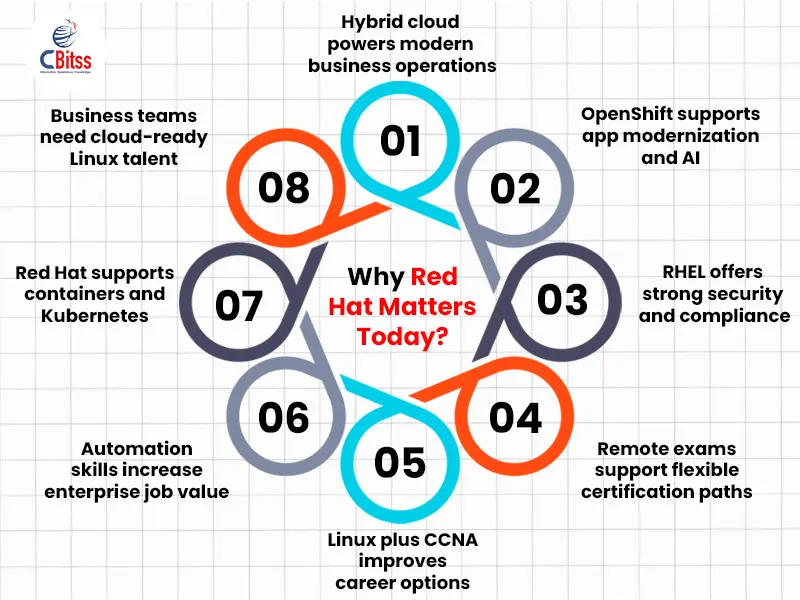
Some people are curious whether Red Hat is conducting a remote exam. The answer is yes, Red Hat is conducting a remote exam. That brings flexibility to the certification journey. Furthermore, this allows you to give your performance-based test from your own home. This provides you with the best environment and enables you to validate your knowledge conveniently.
Today, Red Hat still offers remote individual exams from home or another approved location. Moreover, candidates use a restricted exam environment and remote proctoring during the certification process. Therefore, students should test the hardware, webcam, microphone, internet, and room setup before exam day.
It provides you with a unique approach that gives you a different operating system for an exam, a compatibility tester, and many more. While delivering this live exam, no one should use a particular panel, do any online searches, and no chatting with friends. This also includes everything that needs to access the exam content, a cloud-based lab environment. So that the tester will not face any problem during the online exam, because, in this type of exam, the tester mainly faces issues regarding unsupported software and other software conflicts. CBitss is allowing you to get to know more about this so that you can make a colourful career.
Master Red Hat and Its Role in Business networks.
Why prefer Red Hat for business purposes?
Secure design Red Hat
Red Hat Enterprise Linux is widely popular for its secure engineering. It has got high-level security recognition in the world. Also, this is highly secure because, first, there is no third-party intervention in the system, and second, open-source transparency supports trust.
Above all, RHEL uses SELinux and mandatory access controls to strengthen enterprise security. Also, RHEL supports FIPS mode and Common Criteria certifications for regulated business environments. Consequently, banks, telecoms, healthcare teams, and governments often trust Red Hat for compliant infrastructure.
Legal protection
Red Hat assures legal safety to its customers. Furthermore, enterprise subscriptions also help businesses access tested software, updates, and support channels faster.
Quick cybersecurity response
Because of its relationship with cybersecurity organizations and the large community, it can fix critical threats quickly after identification. Moreover, Red Hat releases security advisories and patches through its enterprise support ecosystem.
Product testing
It has a policy of testing hardware before release in the market. They are very conscious about their products, so before releasing them, they perform thorough quality testing. Likewise, Red Hat tests hardware and software compatibility before certifying supported enterprise platforms.
Long-lasting support service
It provides 24/7 support for business, and it has a policy to support its products. Moreover, long lifecycle support helps businesses plan updates without constant disruption or rushed migrations.
Reasonable price
This is available at a reasonable price. Need to take a subscription first, and after that, there is no major cost burden for many services. Therefore, subscription pricing suits enterprises that want support, patches, and predictable operations.
Learn Red Hat and Its Role in Business infrastructure
Why Red Hat skills matter for students
- Meanwhile, employers now expect Linux administrators to understand containers, Kubernetes, automation, and cloud-native workflows.
- Similarly, Red Hat OpenShift helps teams modernize legacy applications without abandoning business-critical systems.
- In addition, Red Hat AI supports predictive and generative AI workloads across hybrid cloud environments.
- As a result, Linux professionals who learn automation and AI stay relevant in modern infrastructure teams.
Linux training in Chandigarh
Overall, choose Linux training in Chandigarh if you want administration, containers, security, and enterprise support skills. Consequently, explore job opportunities after CCNA, after you add Linux, automation, and cloud skills. Above all, pair CCNA training in Chandigarh with Red Hat skills for stronger network automation careers.
Related tech learning paths
- Meanwhile, product teams also value what is UI UX when they build admin panels and customer dashboards.
- Likewise, backend learners should understand what is PHP before deploying web applications on cloud platforms.
- Therefore, students should review things to consider before learning PHP language before selecting server-side tools.
- Similarly, mobile developers using what is the Android Studio also benefit from Linux and container skills.
- Furthermore, creative teams can explore what is Adobe Photoshop for branding, interface assets, and campaign support is.
- Moreover, learners should understand the types of machine learning before working with AI-enabled enterprise platforms.
In conclusion, Red Hat helps businesses unite Linux, automation, cloud, security, and AI on one enterprise path. Therefore, students who build these skills now can serve modern business infrastructure with more confidence. To know more, join Linux training in Chandigarh

J. Julia Kamei is a professional content writer with 4+ years’ experience creating impactful content for clients in the USA, India, Canada, the UK, and Europe. An M.A. History graduate, she specializes in immigration, business, IT, digital marketing, AI, and Data Science. She also mentors students for international education and research.