


Table of Contents
ToggleIntroduction
Have you ever noticed that there are web pages that load immediately and are responsive even with complicated components? It is frequently the secret of a strong browser technology: How Shadow DOM Improves Web Speed. The global developers are currently studying the ways of using this invisible layer of HTML wizardry to improve performance and isolate design to render faster.
Here in this article, you will discover what is the shadow DOM, how it works in the background, and how it can change the manner in which you create modern blistering websites.
Dive into the types of machine learning that power modern AI applications.
What Is Shadow DOM?
To get a clue of this conception, we should begin with the fundamentals of what is shadow DOM. It is also an aspect of the Web Components standard that enables application developers to package HTML, CSS, and JavaScript into self-contained modules. This implies that styles and scripts within a shadow tree will not leak into the rest of the page, and external styles will also not intrude on it.
So, what is a Shadow DOM in Web Development? It is basically a sort of mini-DOM that is attached to an element and that is an independent one and not part of your main document. Due to the speed of browsers in making these isolated structures work, your components become predictable and efficient.
Learn why businesses are making the shift to serverless and microservices for scalable cloud architectures.
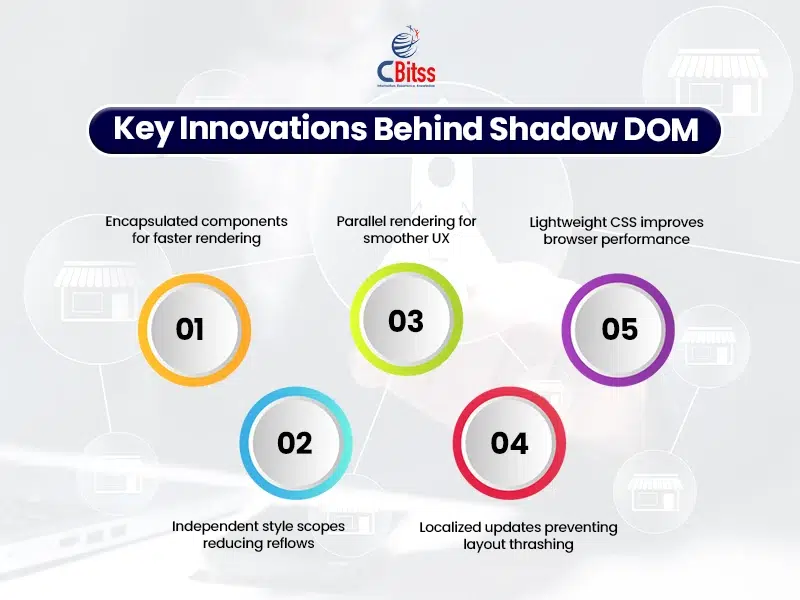
Why Encapsulation Improves Performance
All the shadow trees are executed independently and reduce reflows on layout.
- Local scoping styles discourage global conflicts in CSS.
- The cost of repaint is minimized as the cost of updating the DOM is independent.
- Shadowed elements are loaded asynchronously, making render time better.
- Usage of memory is reduced due to the reduced number of recalculations of the style.
When the content is handled in smaller chunks by the browsers, it drastically increases the speed of rendering. This isolation concept is among the key motivations of How Shadow DOM Improves Web Speed on a large scale.
Get a comprehensive guide on Microsoft Azure and its cloud services.
What Is a Shadow DOM in Web Development?
What is a shadow DOM in web development is, in simple terms, the development of the front-end engineer in creating scalable interfaces. Conventionally, styles and scripts existed in global namespaces, and debugging and optimization were challenging.
Shadow DOM has its own environment in each component. Therefore, more recent systems such as React and Vue can take advantage of shadow roots to isolate code, so no CSS override or script conflict takes place. This separation simplifies the rendering of the browser and enables the teams to develop UI components at an independent level without any fear of ruining the global designs.
Discover tips to create the best homepage design that converts visitors effectively.
Improve UI isolation and performance using Shadow DOM in advanced front-end development.
The Practical Impact of Shadow DOM on Speed
We cannot say that improvements are theoretical when we discuss how Shadow DOM Improves Web Speed, because they are quantifiable. Moreover, Shadow DOM avoids global recalculations and speeds up pages with many dynamic updates.
Since each shadow root is doing updates on a local basis, it reduces layout thrashing – the re-rendering of elements that happens all the time. Besides, scoped styles are only used on their component, thereby reducing the time of CSS parsing dramatically. This leads to more seamless transitions, quicker interaction, and a more stable experience for the user.
Understand the role of data ethics and governance in modern data science for responsible AI.
How to Find Shadow DOM Elements
Encapsulated elements are a confusing concept to work with initially. The question that developers frequently use to debug is how to find shadow DOM elements. Moreover, you can do it through your browser DevTools:
- Open Chrome or Edge DevTools.
- Find the parent web element in the Elements tab.
- Elaborate on the node marked by the symbol shadow-root.
- Examine what internally the global space sees as the inner workings of the DOM.
- Change items with a high level of security, without interfering with external styles.
These operations provide you with an insight into shadow structures whilst maintaining their isolation. After having learned how to find shadow DOM elements, debugging and performance tuning become much easier.
Enhance your skills with neural network courses for deep learning projects.
The Hidden Advantage of Shadow DOM In Web Speed
Parallel rendering is one of the best assets of How Shadow DOM Improves Web Speed. Browsers do not take time to load a complete page before showing the content, since they can work on shadow roots. This non-blocking nature makes the user have the impression of real-time communication.
Furthermore, the developers can lazy-load the components, i.e., the unused features will be inactive until required. The outcome is speedier initial paint, minimal cumulative layout displacement, as well as better overall performance.
Find the best opportunities at the top 5 digital marketing institutes in Chandigarh to boost your marketing career.
Prevent style leakage and improve maintainability with Shadow DOM integration.
React Shadow DOM: Bridging Modern Frameworks
React Shadow DOM integration gives the developer the benefits of the declarative UI of React and the encapsulation offered by Shadow DOM. Any React element may render in a shadow root of its own, isolating the styles and enhancing runtime performance.
The method improves modularity and reusability, particularly in design systems. In addition, React Shadow DOM, when used together with server-side rendering, decreases the load of computation on the client-side, and even intricate pages remain lightning-fast.
Common Mistakes and Fixes
As a rule, excessive use of the global selectors overrides shadow styles.
- Leaving shadow roots unclosed or undetected.
- Omitting the quality of accessibility in shadow content.
- The inability to manage script dependencies on a global basis.
- The fact that not all nested shadow tree optimization works towards minimum reflow.
Therefore, you guarantee the efficiency and maintainability of your implementation when you avoid these mistakes. Every fix conserves the performance gains that ensure Shadow DOM Improves Web Speed is effective to such an extent.
Decide if PPC is really essential for any business in your marketing strategy.
Closing Shadow DOM: Why It Matters
However, they also reduce debugging visibility, so instead you should use a closed Shadow DOM to balance safety with real-world needs. This provides a high level of encapsulation, which enhances security and stability.
Closed roots eliminate the possibility of accidental manipulation that may make rendering slow or add bugs to the code. However, they also reduce debugging visibility, so you should use a closed Shadow DOM to balance safety with real-world needs.
Shadow DOM vs. Traditional DOM
| Feature / Aspect | Shadow DOM | Traditional DOM |
| Rendering Performance | Renders faster due to localized recalculations | Updates often cause full-page reflows |
| CSS Encapsulation | Shadow roots protect CSS from global overrides | Global DOM requires constant style maintenance |
| Coding Practices | Encourages modular and reusable coding | Less modular; components are more dependent on global styles |
| Overall Benefit | Faster page rendering and improved performance metrics | Slower rendering; higher maintenance overhead |
Visualize data effectively with the best data visualization tools available today.
Best Practices for Optimizing with Shadow DOM
To utilize the entire power of Shadow DOM:
- Shadow trees should be shallow to minimize the depth of rendering.
- Restrict inline scripts, external dependencies.
- Therefore, use lightweight CSS inside every shadow root to keep styles fast and efficient.
- Use caching as far as reusable templates are concerned.
- Performance monitoring using Chrome’s Lighthouse tool.
Such strategies will help you understand what is the Shadow DOM and ensure that your applications load quickly and are responsive even during traffic.
Future of Web Development with Shadow DOM
The future of front-end development is based on modularity, speed, and maintainability. Shadow DOM offers all three. Integration will be smooth as frameworks will change. Moreover, innovations such as the declarative shadow roots and native browser optimization will render the encapsulated rendering even more efficient.
Thus, knowing what is the Shadow DOM nowadays makes developers ready to work in the web architecture of tomorrow, in which even a single millisecond of load time counts.
Learn the key differences between SEO and PPC to optimize your campaigns.

Conclusion
How Shadow DOM Improves Web Speed is not so much about speed, but one should be designing smarter. Knowing what is Shadow DOM, how to find its elements, and even testing how to close Shadow DOM, programmers can develop applications that are faster, safer, and allow them to be more modular.
Finally, Shadow DOM makes websites ecosystems. It makes the complex simple, less invasive, and gives the speed that users need, at the same time keeping your codebase lean, current, and future-proof.
Explore how the best digital marketing company in India can grow your brand online.

Sukhamrit Kaur
Sukhamrit Kaur is an SEO writer who loves simplifying complex topics. She has helped companies like Data World, DataCamp, and Rask AI create engaging and informative content for their audiences. You can connect with her on LinkedIn.