

Table of Contents
ToggleIntroduction
Data science today requires a stronger emphasis on data ethics and governance than any previous era. Ethical guidelines and governance structures become vital when businesses and organizations choose to base their decisions on data analysis to ensure transparency and fairness alongside accountability. The misuse of sensitive information in our data-centric environment creates risks such as privacy violations and discriminatory decisions and can result in legal consequences. Responsible data science demands a combination of ethical principles with strong governance systems.
Moreover, data ethics and governance in modern data science now shape trustworthy analytics at every stage. Therefore, teams must review consent, purpose, access, and retention before training or reusing data. Likewise, privacy-first design now improves trust, compliance, and long-term business value.
Understanding Data Ethics
What is Data Ethics?
Data ethics encompasses the ethical responsibilities related to the collection and processing and utilization of data. Data practices must operate according to values including fairness, privacy, and transparency.
Additionally, ethical teams document data sources, model limits, and possible harms before deployment. For example, web crawler fundamentals help teams review how online data gets collected.
Key Principles of Data Ethics
Fairness – Maintain fairness by ensuring that decisions based on data analysis treat all groups equally.
Privacy – Protect people’s rights by safeguarding their personal and sensitive information.
Transparency – Make data processes and algorithms understandable.
Accountability – Assign responsibility to those who practice data management to ensure their methods remain ethically sound.
Consent – Collect data only after securing explicit informed permission from individuals.
Why Data Ethics Matters
- Prevents bias and discrimination in AI models.
- Enhances trust between organizations and customers.
- Protects against risks stemming from privacy violations and improper data handling.
- Ensures compliance with legal and regulatory requirements.
Similarly, Android vs iOS privacy choices remind teams that platforms shape permissions and user expectations. Likewise, clear consent design helps users understand how systems collect and apply data.
Stay ahead of the curve by learning AI-powered design techniques for the web.
Exploring Data Governance
What is Data Governance?
Data governance consists of policies and frameworks that manage processes to maintain data quality and security while ensuring regulatory compliance. The system provides explicit rules for handling data throughout its entire lifecycle.
Additionally, modern governance now includes lineage, access logs, model monitoring, and audit readiness.
Key Component | Description |
Data Quality | Ensures accuracy, consistency, and completeness of data. |
Data Security | Protects data from unauthorized access and breaches. |
Compliance | Adheres to legal and industry regulations (GDPR, CCPA). |
Metadata Management | Maintains detailed information about data assets. |
Data Stewardship | Assigns roles and responsibilities for data management. |
Importance of Data Governance
- Enhances Data Integrity – Data Integrity Enhancement provides trustworthy and reliable data essential for making decisions.
- Regulatory Compliance – Organizations achieve adherence to international data protection regulations through regulatory compliance.
- Data Security – Data Security defends against unauthorized data access and cyber threats.
- Improves Efficiency – Enhances organizational performance through efficient data process streamlining and inconsistency reduction.
- Facilitates Collaboration – Facilitates Collaboration by enabling smooth data exchange between multiple departments.
Similarly, WooCommerce in WordPress sites need careful governance for customer, order, and payment-related data.
Stay ahead of the curve by learning AI-powered
Modern Priorities in Ethical Data Science
- However, modern teams also track consent logs, policy updates, and model changes for audits.
- Likewise, single-page vs multi-page websites affect how users discover policies, notices, and consent choices.
- Consequently, responsible governance now connects legal, technical, and business teams more closely.
Challenges in Data Ethics and Governance
While ethical data practices and governance frameworks hold great importance multiple challenges arise during their implementation.
Bias in Data and Algorithms – Data sets that contain biased representations generate biased results from artificial intelligence systems.
Data Privacy Concerns – Organizations face difficulties in maintaining both data utility and privacy protection.
Regulatory Complexity – The need to follow various regulations across different regions presents significant operational challenges.
Lack of Awareness – Numerous businesses fail to address ethical considerations during their data handling operations.
Inconsistent Data Governance Practices – The adoption of varied data policies by different departments leads to fragmentation due to inconsistent data governance practices.
However, generative AI also increases risks like leakage, hallucinations, and weak accountability. Therefore, organizations should review both training data and model outputs regularly.
How to Implement Ethical Data Governance?
To incorporate ethical practices into their data management systems organizations need to implement a well-defined framework. Here’s how:
Develop Ethical Guidelines
Create ethical standards to direct proper data collection and use.
Ensure transparency in data-driven decision-making.
Therefore, teams should define purpose before reusing data across products, regions, or vendors.
Implement Strong Data Security Measures
Encrypt sensitive data to prevent breaches.
Regularly audit security practices to identify vulnerabilities.
Moreover, role-based access should limit who can view, edit, export, or train on data.
Encourage Ethical AI Practices
Use diverse datasets to minimize bias.
Conduct fairness assessments on machine learning models.
Likewise, teams should test models after launch because bias can return through drift.
Foster a Culture of Data Responsibility
Educate employees on ethical data handling.
Appoint data stewards for compliance supervision and best practice management.
Additionally, regular training builds stronger judgment during data labeling, analysis, and reporting.
Skills That Strengthen Responsible Data Work
Moreover, Python training for data science helps teams automate quality checks responsibly.
Similarly, a Java online course with certificate supports governed enterprise application development.
Likewise, a practical UI UX course improves consent flows and ethical user communication.
Furthermore, best PPT apps help teams explain risks, audits, and decisions clearly.
Leverage Technology for Ethical Data Governance
Technology | Purpose |
AI Ethics Toolkits | Assess fairness and bias in AI models. |
Blockchain | Enhances data security and transparency. |
Data Anonymization Tools | Protects personal identities while using datasets. |
Automated Compliance Software | Ensures adherence to regulatory standards. |
Real-World Examples of Ethical Data Governance
Case Study 1: GDPR Compliance in the European Union
The General Data Protection Regulation (GDPR) mandates rigorous protocols for acquiring data and obtaining user permissions. Businesses operating in the European Union need to follow transparent data practices while providing user data access and maintaining secure data storage methods.
Therefore, privacy-focused planning works best when teams collect only necessary information.
Case Study 2: AI Bias in Hiring Systems
The top tech company found biased behavior in its artificial intelligence-based recruitment system. Biased historical data caused the system to show a preference for male candidates. The company addressed the issue by conducting fairness assessments and expanding their training datasets to achieve unbiased hiring outcomes.
Likewise, continuous review helps teams catch bias before it harms real people.
Case Study 3: Financial Institutions Enhancing Data Security
International banks utilize strong encryption and fraud detection systems to safeguard customer information. Ethical governance practices within financial sectors protect against identity theft and prevent unauthorized transactions.
Similarly, strong governance protects trust as much as it protects data.

Future of Data Ethics and Governance
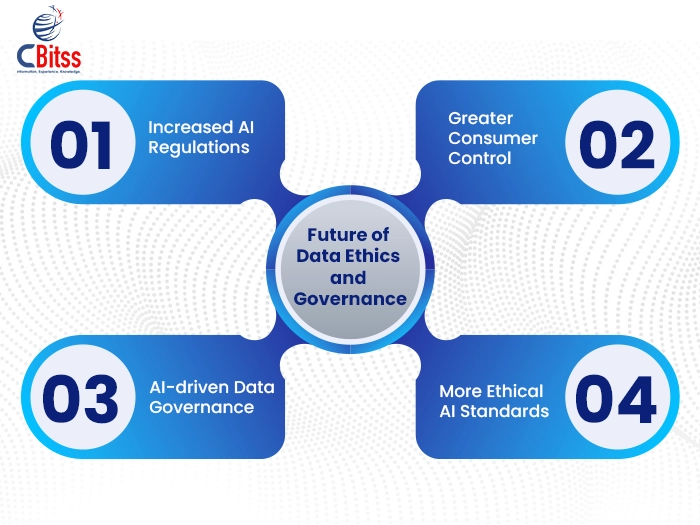
With technological advancements, the significance of data ethics and governance continues to expand. Future trends include:
- Increased AI Regulations– New AI regulations will require governments to implement more rigorous standards for transparency and accountability in AI systems.
- Greater Consumer Control –Users will achieve enhanced control over their data through improved privacy tools that increase their power to manage personal information.
- AI-driven Data Governance– Machine learning techniques will drive automated processes for compliance monitoring and data security in AI-driven Data Governance.
- More Ethical AI Standards– Organizations will implement universal guidelines to maintain ethical AI operations.
Consequently, organizations now combine governance rules with human review and technical monitoring. Moreover, future-ready teams will treat ethics as a design rule, not a final checklist.
Modern data science needs strong data ethics and governance for responsible technological innovation and trust-building. Organizations can protect personal privacy while promoting fairness and strengthening data security through the adoption of ethical principles and governance structures. The expansion of digital environments requires companies to focus on ethical data handling to establish trustworthiness and stay compliant with changing regulations. Data ethics and governance frameworks, when properly implemented, result in long-term responsible data practices within the field of modern data science.
Finally, ethical data science succeeds when fairness, security, usability, and accountability work together. Therefore, responsible teams build trust before they scale models, products, or platforms.

Sukhamrit Kaur
Sukhamrit Kaur is an SEO writer who loves simplifying complex topics. She has helped companies like Data World, DataCamp, and Rask AI create engaging and informative content for their audiences. You can connect with her on LinkedIn.