

Table of Contents
ToggleMaster SQL from the Best in Chandigarh
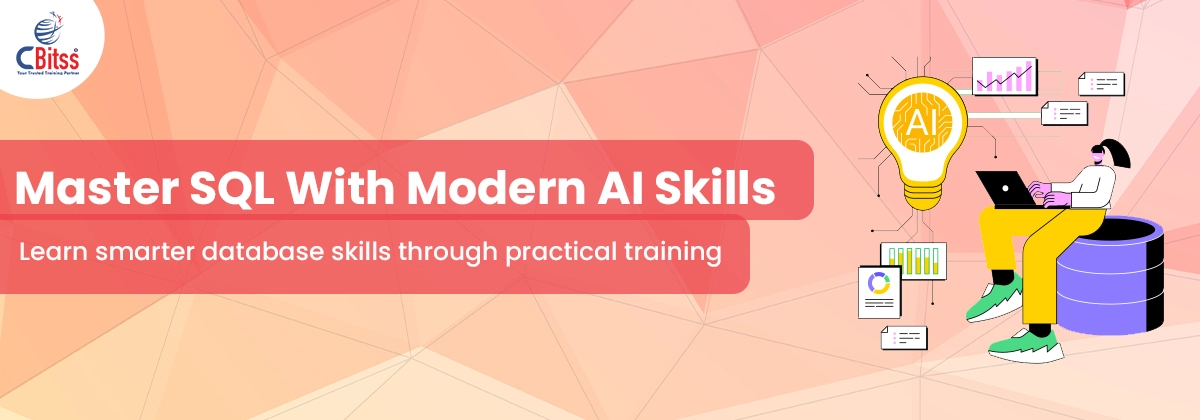
Structured Query Language (SQL) continues to serve as the foundation for data management in today’s expanding digital economy. Data analysts, database administrators, and backend developers will find that SQL knowledge is fundamental to their career success. Chandigarh hosts several esteemed government-recognized institutes that provide professional, practical training in SQL and database management. This article reviews the top 5 SQL Institutes in Chandigarh that stand out for their professional expertise, modern educational approaches, and practical project experiences. You’ll find a perfect match for your career goals from AI-integrated programs to university-certified courses in this Top 5 SQL Institutes list in Chandigarh.
Moreover, modern SQL skills now extend beyond writing traditional database queries. Today, learners increasingly explore natural-language querying, AI-assisted optimization, cloud databases, vector search, and intelligent database agents.
Therefore, SQL training that combines database fundamentals with modern AI workflows can better reflect changing industry requirements. Additionally, students seeking stronger programming skills can explore advanced Python programming. Python and SQL frequently work together across analytics, automation, machine learning, and data engineering projects.

Top 5 SQL Institutes in Chandigarh (Govt-Recognized)
1. CBitss Technologies
CBitss Technologies offers SQL training boosted by artificial intelligence to equip students with the skills needed for the future.
Location: SCO 23-24-25, 3rd Floor, Sector 34A, Chandigarh
Government Recognized: Yes
Contact: +91-9988741983 | poc@cbitss.org | www.cbitss.in/sql-training-in-chandigarh
CBitss stands as the premier AI-driven SQL institute in Chandigarh, offering hands-on SQL training enhanced by artificial intelligence. Students learn SQL queries and database design, and join operations alongside advanced AI-driven tools for query optimization and data insights through CBitss’s innovative program. Students gain preparedness for modern data-focused positions through CBitss’s project-based training and industry-aligned course modules. CBitss provides certification and placement assistance as well as real-time exposure to deliver a complete learning package for SQL mastery.
Moreover, modern database training can introduce natural-language-to-SQL tools that convert everyday questions into structured database queries. However, learners must still understand joins, schemas, filters, indexes, and query logic to verify AI-generated results. Therefore, strong SQL fundamentals remain essential even when artificial intelligence assists with query generation.
Stay ahead of the curve by learning AI-powered design techniques for the web.
How AI Is Changing Modern SQL Skills
- Artificial intelligence is changing database workflows rather than replacing the need to understand SQL.
- For example, modern database platforms can generate, execute, explain, and refine SQL using natural-language prompts.
- Additionally, AI tools can inspect database structures and provide contextual query suggestions based on available tables and relationships.
- However, an executable AI-generated query does not automatically mean that its business logic is correct.
- Therefore, developers and analysts must verify joins, filters, metrics, permissions, and returned results before making decisions.
- Furthermore, databases are increasingly supporting semantic search alongside traditional relational queries.
- Vector search allows applications to retrieve information based on meaning rather than exact keyword matches.
- Consequently, SQL knowledge is becoming increasingly useful for AI applications, RAG systems, and intelligent enterprise search.
- Meanwhile, learners can strengthen database foundations through practical MySQL training.
2. NIELIT Chandigarh
Location: SCO 114-116, Sector 17B, Chandigarh
Government Recognized: Yes
Contact: +91-172-2703283 | chd@nielit.gov.in
It delivers a 4-week Oracle SQL Certificate that teaches students all essential database fundamentals, including how to create tables and perform database queries. As an agency within the Ministry of Electronics and IT, this institution offers high-standard training at reasonable prices. While AI-enhanced modules are not included, the institution remains attractive to government job seekers and foundational database learners because of its certification and structured training approach.
3. Punjab Engineering College (PEC)
Location: Sector 12, Chandigarh
Government Recognized: Yes
Contact: +91-172-2753051 | registrar@pec.ac.in
This integrates SQL and database management instruction into its Computer Science and Engineering program. Here, students develop comprehensive knowledge of database systems through workshops and elective courses as well as research-driven projects. It does not teach SQL with AI tools, but its rigorous academic standards and recognition as a SQL training institute provide lasting advantages to technical students.
Furthermore, students interested in broader programming foundations can understand what Python is. Python complements SQL especially well across data processing, analytics, backend development, automation, and artificial intelligence applications.
4. Chandigarh University
Location: NH-95 Chandigarh-Ludhiana Highway, Mohali
Government Recognized: Yes
Contact: +91-160-3051003 | info@cumail.in
Through its B.Tech and MCA programs, this university provides specialized training in Database Management Systems (DBMS). The curriculum enables students to gain proficiency in SQL and NoSQL databases, along with database design techniques and cloud database management. The university applies AI technology to enhance database optimization and data warehousing, which makes it an advanced choice for both undergraduate students and working professionals.
5. The University Institute of Engineering and Technology at Panjab University
Location: Sector 25, Chandigarh
Government Recognized: Yes
Contact: +91-172-2541242 | uiet@pu.ac.in
This University offers SQL and database courses through elective subjects and practical skill-based workshops. It has no AI concentration but combines academic rigor with practical exercises and collaborative work between departments to build students’ SQL database skills.
Comparison Table of Top 5 SQL Institutes in Chandigarh
Institute | Govt Recognized | AI Integration | Key Benefits |
CBitss Technologies | ✅ Yes | ✅ Yes | AI-powered SQL training, industry projects, placement support, Academic-focused SQL workshops, |
NIELIT Chandigarh | ✅ Yes | ❌ No | Oracle-based certificate, short-term course, affordable govt. program |
PEC Chandigarh | ✅ Yes | ❌ No | Engineering-level depth, research exposure, strong alumni network |
Chandigarh University | ✅ Yes | ✅ Partial | Modern curriculum, cloud DB, AI introduction, good infrastructure |
UIET, Panjab University | ✅ Yes | ❌ No | Academic-focused SQL workshops, elective options, Panjab University certification |
AI in SQL – What Does It Mean?
The ongoing advancements in technology allow Artificial Intelligence to transform how we interact with databases through SQL. AI makes SQL smarter and more efficient by eliminating the need to write complex queries manually and speeding up result processing.
Moreover, AI can now translate natural-language questions into SQL, explain queries, and assist with database troubleshooting. Additionally, database platforms increasingly combine relational data with generative AI and semantic search capabilities.
1. Predictive Querying
Artificial Intelligence technology now has the ability to determine your informational goals before your SQL query reaches completion. This system functions in a similar manner to the way Google predicts your search entries.
Moreover, contextual AI systems can examine schemas, previous queries, metadata, and user intent before suggesting appropriate SQL.
Example: When analyzing sales data where you frequently search for “monthly revenue by region,” the system will automatically recommend similar or additional queries.
Why it matters: This feature both accelerates data retrieval processes and provides support to novice users unfamiliar with precise SQL syntax.
2. Auto-Query Suggestions
AI-driven SQL tools provide real-time SQL syntax suggestions while you type, similar to Gmail’s auto-complete feature.
Moreover, modern assistants can generate complete queries from natural-language instructions instead of suggesting individual clauses only.
Example: AI-powered systems respond to the SELECT keyword by suggesting the FROM and WHERE clauses or frequently used table names from your database.
Why it matters: The tool prevents mistakes while accelerating the development of queries and simplifying SQL usage for beginners and non-technical users.
However, learners should review generated queries because AI can misunderstand schemas, joins, or business definitions.
3. Query Optimization
AI capabilities enable the analysis of your query execution and automatic performance enhancement. The tool examines duplicate operations and slow joins, along with unnecessary data retrievals. Additionally, modern AI assistants can analyze execution plans, dependencies, and database objects before recommending improvements.
Example: When your SQL query takes an excessive amount of time to retrieve results, AI systems can provide a revised version or make necessary optimizations without user intervention.
Why it matters: This enhancement speeds up your database operations while avoiding performance drops, which benefits large companies working with massive data collections.
4. Smart Database Indexing
AI analyzes common data search patterns to generate indexes that improve search speed automatically.
Example: When multiple users execute searches on the “customer_name” column, AI generates an index for this column, which prevents full-row scans during each search.
Why it matters: Indexing enhances search speed substantially and allows quicker report generation in sizable databases.
Natural-Language-to-SQL Is Growing
- One of the strongest database trends is the movement from manual query creation toward conversational data interaction.
- Instead of remembering every command, users can increasingly describe the information they need using normal language.
- Then, AI models translate those requests into structured database queries.
- Consequently, analysts and business users can explore information faster without manually constructing every SQL statement.
- However, natural-language systems work best when grounded in accurate schemas, approved metrics, and relevant database context.
- Therefore, SQL professionals remain important for validating generated queries and protecting data quality.
- For beginners, understanding Python programming basics can also support broader data workflows.
Vector Search Meets Traditional SQL
- Another major development is the combination of relational SQL databases with vector search.
- Vector search represents text, images, and other information as numerical embeddings for semantic retrieval.
- Therefore, applications can search for conceptually similar information instead of relying entirely on exact keywords.
- Furthermore, developers can combine structured filters with semantic similarity inside modern database workflows.
- This combination is particularly valuable for enterprise search, recommendation engines, assistants, and retrieval-augmented generation.
- Moreover, integrated vector capabilities reduce the need to maintain entirely separate databases for some AI workloads.
AI Database Agents Are Emerging
- AI database agents represent another important shift in database administration and development.
- These agents can assist with monitoring, troubleshooting, configuration, query analysis, and other multi-step database activities.
- Furthermore, agentic tools can inspect database context before recommending or performing permitted actions.
- As a result, database professionals can spend less time handling repetitive operational tasks.
- However, human oversight, security controls, permissions, and validation remain essential for production database environments.
- Meanwhile, following latest Python trends can help learners understand complementary automation technologies.
Stay ahead of the curve by learning AI-powered
SQL and AI Need Human Validation
- Although AI can generate SQL rapidly, speed does not guarantee accuracy.
- For example, an incorrect join can return believable results while silently duplicating records.
- Similarly, AI may select the wrong date column, metric definition, aggregation, or business filter.
- Therefore, professionals must understand the SQL generated by AI before relying on its output.
- Furthermore, secure systems should limit database access according to roles and approved permissions.
- This makes SQL knowledge even more important because professionals must validate automated decisions rather than blindly accept them.
- Before expanding into automation, beginners can review learning Python essentials.
Final Thoughts
SQL serves as an essential skill across data analytics, web development, and software engineering disciplines. Selecting an appropriate institute is essential for getting the most from your learning journey. This ranking presents the top 5 SQL training institutes in Chandigarh that offer both basic and advanced learning opportunities. CBitss Technologies stands out as the premier option for AI-powered SQL training thanks to its advanced curriculum and project-based learning approach, along with government-recognized certification. Institutions such as NIELIT, PEC, Chandigarh University, and UIET provide robust academic programs that benefit from their strong faculty credentials and institutional reputation. Additionally, understanding the differences between online vs SQL classroom training helps you choose a format that best suits your schedule and learning preferences.
Moreover, SQL is expanding beyond traditional database querying into natural-language analytics, vector search, and AI-assisted workflows. Therefore, learners should combine SQL fundamentals with database design, optimization, cloud concepts, and responsible AI usage. At the same time, Python knowledge can strengthen automation, analytics, and artificial intelligence development skills.
Consequently, professionals who understand both database fundamentals and AI-assisted tools can adapt more effectively to modern data roles. Select the educational path that most closely aligns with your objectives and begin your journey into database technology with confidence.

Sukhamrit Kaur
Sukhamrit Kaur is an SEO writer who loves simplifying complex topics. She has helped companies like Data World, DataCamp, and Rask AI create engaging and informative content for their audiences. You can connect with her on LinkedIn.