

Table of Contents
ToggleIntroduction
How to choose the Right Cloud Service Provider for using Tally? In today’s digital world, managing financial data securely and efficiently has become vital for businesses. That’s why many firms are now using Tally on Cloud, a modern solution that helps access Tally software remotely with better performance and protection. However, to use it effectively, selecting the right cloud service provider becomes crucial.
Moreover, businesses now expect cloud accounting systems to provide secure access, reliable backups, and consistent performance.
Therefore, the right provider should balance security, scalability, licensing, recovery options, support, and predictable costs.
Additionally, cloud hosting allows employees and accountants to access centralized financial information from different locations.
Consequently, businesses can improve collaboration without depending completely on physical office computers or local servers.
Furthermore, professionals exploring cloud technologies can understand fundamentals through a cloud computing course.
Therefore, understanding cloud architecture can make provider comparisons easier and more practical.
What is Cloud Computing?
Simply put, cloud computing is the delivery of computing services such as storage, servers, software, analytics, and more over the internet. These services are highly scalable and flexible, allowing businesses to enhance productivity while saving costs. Moreover, institutes like CBitss Technologies in Chandigarh offer practical cloud computing training to help you understand and implement such technologies better.
Additionally, cloud platforms allow businesses to increase or decrease computing resources according to changing workloads.
Therefore, companies can avoid maintaining oversized infrastructure for occasional periods of increased demand.
Moreover, cloud environments can centralize applications, business files, backups, and user access controls.
Consequently, administrators can manage business resources without maintaining separate systems at every location.
Furthermore, understanding the importance of cloud computing training helps professionals develop practical infrastructure management skills.
Therefore, trained teams can evaluate security, storage, networking, and scalability requirements more effectively.
Benefits of cloud computing
There are several benefits of cloud computing. It is an efficient way of storing data and provides a cost-effective system of various technological services.
Benefits of Cloud Computing for Tally Users
Feature | Description |
Cost Efficiency | Pay-as-you-go models save money over time, reducing infrastructure expenses. |
Remote Access | Access Tally and business data from anywhere, even via smartphones. |
Scalability | Easily increase storage or performance as your company grows. |
Data Protection | Strong encryption and access control improve cloud-based security. |
Automation | Systems update and maintain themselves with minimal manual input. |
Disaster Recovery | Cloud storage provides reliable backups, minimizing the risk of data loss. |
Additionally, centralized hosting can simplify collaboration when several authorized employees need access to financial records. Therefore, businesses can reduce dependency on specific workplace computers for routine accounting activities.
Moreover, dependable cloud environments help companies maintain business continuity during local device failures. As a result, employees can continue important accounting activities through another authorized system.
Stay ahead of the curve by learning AI-powered design techniques for the web.
Why Tally Cloud Hosting Needs Careful Provider Selection
However, moving Tally to the cloud does not automatically guarantee strong performance or security.
Therefore, businesses should examine the provider’s infrastructure before transferring important accounting information.
Moreover, TallyPrime relies on a suitable Windows environment for supported installations and dependable performance.
Consequently, businesses should verify operating systems, processing capacity, memory, storage, and concurrent user capabilities.
Additionally, organizations should examine how the provider handles authentication, permissions, backups, monitoring, and system maintenance.
Therefore, technical specifications should receive as much attention as monthly hosting prices.
Meanwhile, businesses managing distributed infrastructure may also explore edge cloud computing concepts.
Consequently, teams can understand how infrastructure location influences latency, processing, and overall application performance.
How to choose the best Cloud services using Tally?
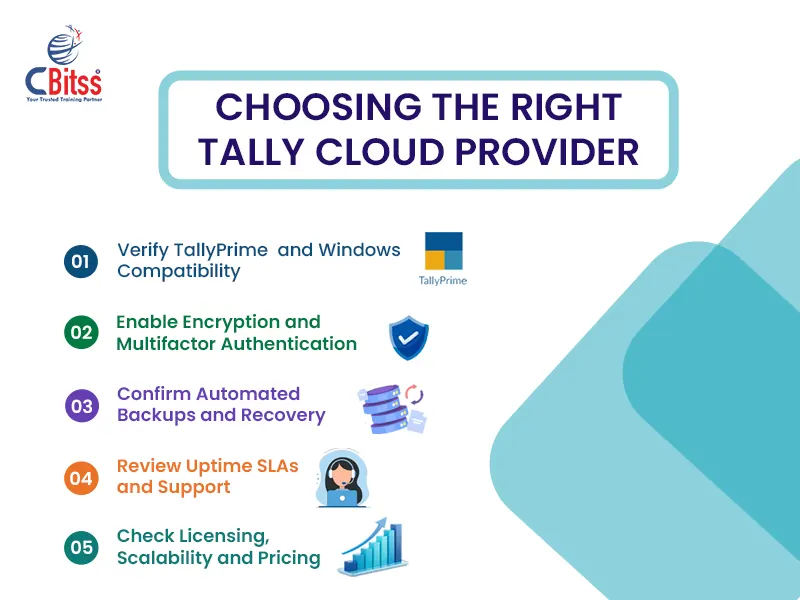
Selecting a cloud provider for Tally requires you to assess both technical elements and strategic considerations. Below are the key aspects to consider:
Technology Compatibility
Ensure compatibility of your current infrastructure with the technologies utilized by the provider before starting. Before deployment, verify that Tally will perform optimally on servers that run Windows with SSD storage capabilities.
Confirm whether the chosen cloud provider offers support for integration through both mobile apps and desktop versions of Tally.
Additionally, verify the supported TallyPrime release before migrating your existing company data.
Therefore, your provider should test application compatibility before completing the production migration.
Moreover, Tally recommends suitable 64-bit Windows environments and adequate memory for reliable application performance.
Consequently, businesses should increase resources when user counts or accounting data volumes grow.
Furthermore, test printers, Excel integrations, custom TDL files, add-ons, and external applications before final deployment.
Therefore, compatibility testing can prevent workflow interruptions after your organization completes migration.
Additionally, technical learners can strengthen related development skills through established coding institutes in Chandigarh.
Consequently, stronger programming knowledge can help teams understand integrations, automation, and software dependencies.
Security Measures and Data Protection
Next, security is paramount. The management of sensitive financial information through Tally requires the implementation of a highly secure cloud data protection system.
It’s essential to inquire about the availability of multi-factor authentication, encryption both at rest and during transit, alongside intrusion detection methods and physical data center protection measures.
The belief that cloud computing lacks security should not be accepted. Established cloud service providers deliver stronger data protection capabilities compared to traditional on-premise systems.
Additionally, businesses should implement strong passwords and restrict administrative privileges to authorized personnel.
Therefore, companies can reduce unnecessary exposure caused by overly broad user permissions.
Moreover, administrators should create different access levels for accountants, managers, operators, and system administrators.
Consequently, employees receive only the permissions required for their assigned responsibilities.
Furthermore, organizations should regularly review active accounts and immediately disable access for departed employees.
Therefore, regular access reviews can reduce risks from forgotten or unnecessary credentials.
Additionally, teams managing Windows and cloud servers may develop administration knowledge through Linux coaching in Chandigarh.
Consequently, broader server knowledge helps technical teams understand infrastructure security and access management principles.
Check Tally Licensing and Virtual Access Requirements
Moreover, businesses should verify Tally licensing before selecting any RDP, virtual desktop, or cloud hosting environment. Therefore, organizations should not assume every hosting arrangement automatically meets Tally licensing requirements. Additionally, Tally Virtual User licensing supports authorized virtual usage through technologies such as RDP and Citrix.
Consequently, businesses using third-party virtual environments should confirm licensing requirements before deployment. Meanwhile, TallyPrime Cloud Access provides another model for businesses requiring centralized remote collaboration. Therefore, companies should compare official Cloud Access with independent hosting before selecting their preferred architecture.
Furthermore, licensing needs may change according to users, business entities, branches, and virtualization methods. Therefore, organizations should discuss their exact deployment scenario with an authorized Tally representative.
Service Delivery & SLA Transparency
You must learn about the delivery process of the service. Request a comprehensive SLA that specifies uptime commitments along with response times and support levels.
This protection prevents service disruption during technical failures or access problems. Additionally, examine whether the SLA clearly defines availability, scheduled maintenance, incident response, and escalation procedures. Therefore, businesses can understand exactly what support they receive during unexpected outages.
Moreover, ask whether the provider offers monitoring outside normal business hours. Consequently, technical teams can identify critical infrastructure problems before employees start their next working session.
Furthermore, verify whether the provider guarantees response targets for critical, major, and minor incidents. Therefore, service expectations remain measurable instead of depending on informal support promises.
Stay ahead of the curve by learning AI-powered
Evaluate Backup and Disaster Recovery
Moreover, dependable Tally hosting requires more than simply storing financial files on a remote server. Therefore, organizations should evaluate backup frequency, retention periods, restoration procedures, and recovery responsibilities.
Additionally, TallyPrime Cloud Access supports automatic backups alongside manual backup options for authorized users. Consequently, organizations can maintain additional recovery copies before major application or configuration changes.
Furthermore, administrators should periodically download important backups and maintain separate protected copies. Therefore, businesses avoid relying completely on one infrastructure environment for every recovery scenario.
Moreover, organizations should test restoration procedures instead of assuming every backup remains usable. Consequently, recovery testing can reveal corrupted files, permission issues, or incomplete backup configurations.
Additionally, businesses should document Recovery Point Objectives and Recovery Time Objectives with their provider. Therefore, both parties understand acceptable data loss and expected restoration times after disruptions.
Scalability & Flexibility
Business growth leads to increased data requirements. Selecting a cloud provider that supports on-demand scalability becomes imperative for businesses. The system needs to support scaling RAM capabilities as well as storage and concurrent user limits without causing any service disruption.
Select vendors that operate multiple data centers to support geographic failover capabilities. Additionally, evaluate whether the provider can increase RAM, processing power, and storage without lengthy migration procedures. Therefore, your Tally environment can support additional employees as business operations expand.
Moreover, ask how quickly the provider can increase concurrent user capacity during seasonal workload increases. Consequently, accounting teams can maintain performance during audits, financial closing periods, or increased transaction volumes. Furthermore, scalable hosting prevents businesses from purchasing excessive resources before they actually need them. Therefore, companies can control costs while retaining room for future expansion.
Review Remote Access Performance
Additionally, remote accounting performance depends heavily on network quality, server resources, user location, and hosting architecture. Therefore, businesses should conduct real-world performance testing before committing to long-term contracts. Moreover, test common activities such as voucher creation, report generation, exports, searches, and printing.
Consequently, employees can confirm that routine accounting tasks remain responsive during normal workloads. Furthermore, businesses should test simultaneous sessions when several employees regularly use Tally together. Therefore, administrators can identify resource limitations before those limitations disrupt everyday operations. Additionally, cloud users should examine browser access, desktop connectivity, session stability, and reconnection behavior. Consequently, employees can maintain productivity when changing networks or working from remote locations.
Compliance and Audit Readiness
Ensure that providers who use Tally for storing financial records meet local compliance requirements like GST audit norms and international standards such as ISO 27001.
Review both internal and external audit reports to confirm their data protection policies.
Additionally, organizations should understand exactly where providers store primary data and backup copies. Therefore, businesses can evaluate data residency requirements before uploading confidential financial information. Moreover, ask providers to explain their security certifications instead of relying only on marketing claims. Consequently, procurement teams can verify whether certifications actually cover the hosting services being purchased.
Furthermore, businesses should maintain audit logs for administrative actions and important access changes. Therefore, investigators can review relevant activity when security concerns or accounting discrepancies arise.
Integration and Supporting Business Systems
Moreover, modern businesses often connect accounting workflows with websites, applications, customer systems, and reporting tools.
Therefore, companies should review integration requirements before finalizing a hosting provider. Additionally, businesses managing websites should understand different types of content management systems and their hosting requirements. Consequently, technical teams can plan infrastructure around several connected business platforms more effectively.
Furthermore, ask whether your cloud provider permits required APIs, database connections, integrations, and approved third-party applications. Therefore, businesses avoid selecting infrastructure that later blocks important automation projects. Meanwhile, integration testing should occur in a controlled environment before teams change production systems. Consequently, administrators can identify compatibility problems without disrupting active accounting operations.
Provider Reputation & Company Health
Confirm the company’s business stability along with customer feedback before making any commitments. A business operating continuously over many years presents a lower risk of unexpected closure, which could endanger your data.
- Find service providers that deliver AI-driven monitoring tools that detect threats.
- Choose a provider that supports role-based access control to reduce the risk of internal data misuse.
- Find out if your data will reside in India or overseas because this can impact compliance requirements.
- Choose service providers who perform routine disaster recovery system tests.
- Implement solutions that enable Tally access using Remote Desktop Protocol (RDP) to maintain fast performance and secure operations.
Additionally, investigate customer feedback related specifically to uptime, Tally performance, support quality, and backup restoration.
Therefore, generic hosting reviews should not become your only source for evaluating providers. Moreover, ask prospective providers how many years they have supported accounting or ERP workloads. Consequently, experienced providers may understand business continuity requirements better than general-purpose hosting vendors.
Furthermore, businesses developing broader technical teams can explore short-term computer institutes in Chandigarh for focused skills. Therefore, practical digital training can complement internal cloud adoption and technology management.
Compare Pricing Beyond the Monthly Hosting Fee
Moreover, the cheapest monthly hosting plan may become expensive after adding users, storage, backups, or support. Therefore, businesses should calculate the complete ownership cost before comparing providers. Additionally, ask about setup charges, migration costs, additional storage, backup retention, bandwidth, and support fees. Consequently, procurement teams can compare providers using realistic costs instead of advertised starting prices.
Furthermore, check whether unused cloud resources continue generating charges when employees stop working. Therefore, scheduled shutdown options can help organizations control unnecessary infrastructure consumption where supported. Moreover, businesses should understand contract renewal prices before accepting introductory hosting discounts. Consequently, long-term budgeting becomes easier when providers disclose future pricing clearly.
Check Data Ownership and Exit Policies
Additionally, your business should retain clear ownership and practical access to its accounting information. Therefore, examine data export and cancellation conditions before signing a hosting agreement. Moreover, ask how quickly you can download complete Tally data after requesting account termination.
Consequently, organizations can migrate providers without becoming unnecessarily dependent on one vendor.
Furthermore, confirm how long providers retain backups after cancellation and when they permanently delete stored information. Therefore, businesses can manage privacy and recovery requirements throughout the contract lifecycle. Additionally, request documentation explaining migration assistance when transferring Tally data to another provider. Consequently, clear exit procedures reduce operational disruption during future infrastructure changes.
Key Features of Cloud-Based Tally Hosting Services
Criteria | Why It Matters |
Real-time Data Access | View and edit Tally entries anytime, enhancing remote work. |
Cloud Backup | Keeps your records safe from hardware failure or accidental deletion. |
Multi-user Access | Teams can collaborate on the same data without overwriting. |
Data Encryption | Provides a layer of cloud-based security against hackers or breaches. |
Support Availability | 24/7 technical support ensures business continuity. |
Customization Options | Allows configuration of storage, bandwidth, or OS depending on your needs. |
Essential Questions to Ask a Tally Cloud Provider
First, ask which TallyPrime versions and licensing configurations the provider currently supports. Additionally, confirm whether the provider supports your expected number of simultaneous users. Next, ask how frequently the platform creates backups and how long it retains them. Moreover, confirm whether administrators can download independent backup copies whenever required.
Furthermore, ask where the provider stores your application data and backup data. Likewise, request details about encryption, authentication, permissions, monitoring, and security incident procedures. Additionally, ask whether the provider offers migration support from your existing Tally environment.
Consequently, you can reduce downtime and prevent avoidable configuration problems during deployment.
Moreover, ask how quickly support teams respond when Tally becomes inaccessible. Therefore, you can compare actual support commitments across shortlisted providers. Finally, review cancellation terms, export procedures, and data deletion policies before signing any agreement. Consequently, your organization retains greater control over its financial information throughout the service lifecycle.
Build Supporting Digital Skills
Moreover, cloud adoption works better when employees understand basic software, security, infrastructure, and digital workflows. Therefore, organizations should develop technical knowledge alongside their cloud migration strategy. Additionally, effective digital communication remains important when businesses document procedures, security policies, and technical workflows. Consequently, learners can explore content writing institutes in Chandigarh for structured communication skills.
Furthermore, well-documented processes help accounting teams follow consistent backup, access, recovery, and security procedures. Therefore, technical knowledge and clear documentation together support safer cloud operations.
Conclusion
Choosing a suitable cloud provider for Tally usage represents a significant business decision with lasting effects on data protection, financial savings, and business efficiency.
A thorough evaluation of potential providers should include checks for technology compatibility and performance levels, as well as data safety protocols and business continuity support.
CBitss Technologies in Chandigarh provides top-tier cloud computing training, which includes practical experience and expert mentorship. The increasing demand for cloud literacy makes this the most opportune moment to take charge of your business through digital and secure leadership.
Overall, businesses should compare providers using security, performance, backups, licensing, scalability, support, compliance, and total costs. Therefore, choosing solely by price can expose organizations to unnecessary technical and operational risks. Moreover, test the proposed Tally environment with realistic workloads before completing a full migration.
Consequently, your team can detect performance, integration, printing, networking, or user-access problems early. Furthermore, review backup restoration procedures and data ownership before signing a long-term cloud hosting agreement. Therefore, your business remains prepared for outages, migrations, security incidents, or future provider changes.
Finally, the right cloud service provider can make Tally access more flexible, manageable, and reliable. Consequently, careful evaluation helps businesses protect financial information while supporting secure digital growth.

Sukhamrit Kaur
Sukhamrit Kaur is an SEO writer who loves simplifying complex topics. She has helped companies like Data World, DataCamp, and Rask AI create engaging and informative content for their audiences. You can connect with her on LinkedIn.