
Table of Contents
ToggleIntroduction
In the modern digital economy, data is more than just a resource—it’s the backbone of strategic decision-making. Companies that leverage data-driven business models consistently outperform those that rely on outdated, intuition-based methods. With a continuous explosion of data from digital platforms, sensors, IoT devices, and enterprise systems, the role of data science has evolved from experimental to essential. As the global market becomes more competitive and interconnected, staying updated with the latest data science trends is critical for organizations aiming to gain a competitive edge.
Moreover, data science is shaping the future of work. It blends computer science, statistics, and domain knowledge to turn raw data into actionable insights. From healthcare to finance to retail, the impact of data science is visible across industries. With technologies like artificial intelligence and machine learning becoming mainstream, understanding the emerging patterns in this field can help individuals and businesses stay ahead.
Furthermore, generative AI and intelligent analytics are changing how professionals explore, summarize, and interpret complex datasets. Therefore, professionals preparing for technical roles increasingly combine analytics knowledge with Android interview preparation and broader programming skills.
Furthermore, generative AI and intelligent analytics are changing how professionals explore, summarize, and interpret complex datasets. Therefore, professionals preparing for technical roles increasingly combine analytics knowledge with Android interview preparation and broader programming skills.
One important aspect to note is that Python is important for data science. It is the most widely used programming language due to its simplicity, vast library ecosystem, and community support. Whether you’re just starting your journey or looking to upskill, learning Python is fundamental to becoming a successful data scientist.
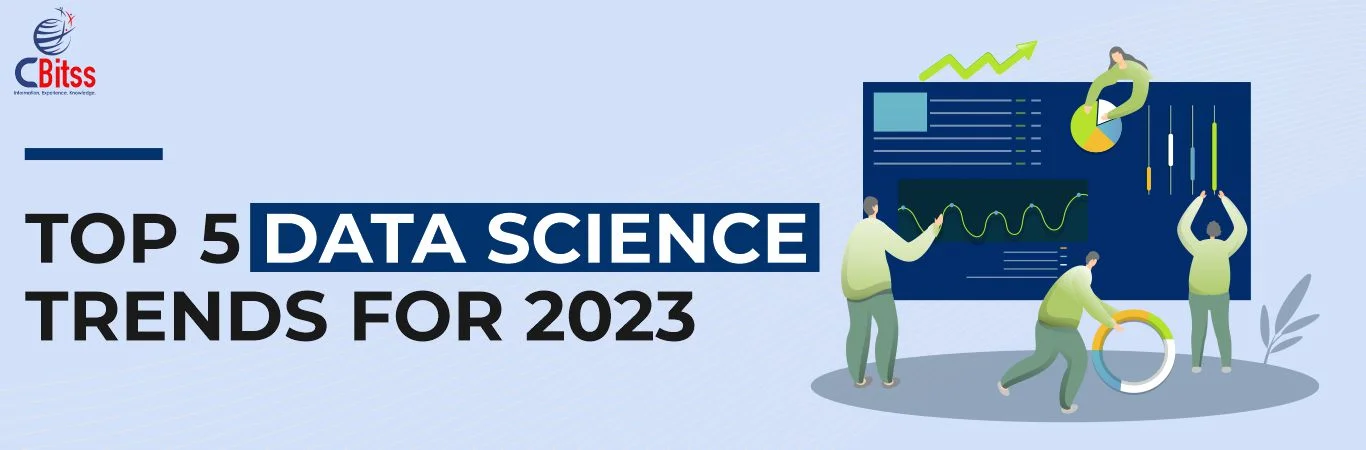
Additionally, the continuing Python programming growth reflects its importance across AI, automation, analytics, and machine learning. So, what lies ahead in the evolving world of data science? Here are five major trends shaping modern data-driven businesses and AI applications.
Analytical Enhancements
The first major trend is the rise of augmented analytics. As a growing component of data science trends, this field combines AI and machine learning to automate data preparation, insight generation, and insight explanation. It reduces the dependency on data scientists to perform manual tasks and empowers business users to access complex analytics tools without needing deep technical knowledge.
Augmented analytics is making a big impact by:
- Automating data analysis workflows
- Generating insights without human bias
- Embedding analytics into everyday applications
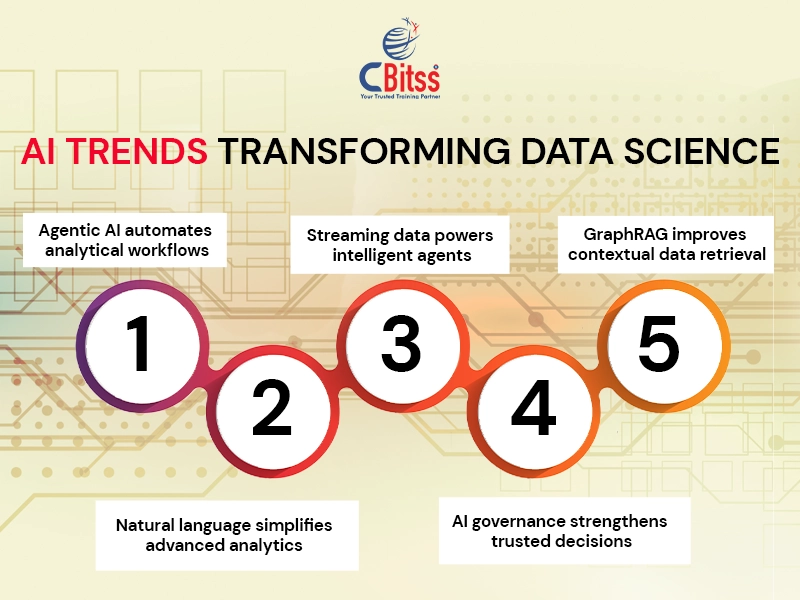
Moreover, generative AI is taking augmented analytics beyond traditional dashboards and automated reports. Users can now ask questions through natural language and receive summaries, explanations, predictions, and visual insights. Additionally, AI agents can investigate datasets, detect patterns, and assist with multi-step analytical workflows.
As a result, analytics platforms are moving toward conversational and increasingly autonomous experiences. However, predictive models and traditional machine learning still provide substantial business value alongside newer generative AI systems. Professionals can also explore emerging data science trends to understand how analytics technologies continue evolving.
Data-as-a-Service (DaaS)
Data-as-a-Service (DaaS) is gaining traction due to its flexibility and cost-efficiency. Built on cloud computing infrastructure, DaaS allows businesses to access, store, and analyze data on-demand, without managing physical servers.
Since the COVID-19 pandemic, the adoption of DaaS has accelerated. The market will reach a value of $11 billion. This trend is particularly valuable in industries such as advertising, e-commerce, and logistics where data-driven agility is critical.
Moreover, cloud-native data platforms increasingly combine analytics, machine learning, generative AI, governance, and data engineering capabilities. Consequently, businesses can build AI applications directly around governed enterprise data without constantly moving information between separate systems.
Key advantages of DaaS:
- Real-time data access from any location
- No upfront hardware investment
- Scalability and integration with multiple data platforms
Furthermore, modern data services increasingly support vector search, AI models, streaming pipelines, and unified data catalogs. Therefore, companies can connect structured and unstructured information to AI applications more efficiently.
As cloud infrastructure becomes more affordable and secure, more businesses will turn to DaaS to scale their data operations. Meanwhile, emerging quantum computing applications are encouraging researchers to explore hybrid quantum and classical analytical workflows.
Stay ahead of the curve by learning AI-powered design techniques for the web.
AI Governance and Data Administration
Data governance is more than a buzzword—it is now essential for trustworthy analytics and artificial intelligence. As organizations deploy generative AI and autonomous agents, governance must cover both data and automated decisions.
With regulations like the European Union’s General Data Protection Regulation (GDPR) setting the precedent, more countries are expected to follow suit. According to Gartner, over 65% of the global population will be covered under some form of data privacy regulation. Moreover, organizations increasingly need visibility into data lineage, model inputs, AI outputs, permissions, and automated decisions.
For businesses, this means:
- Increased audits and documentation
- Standardizing data formats and quality
- Building transparent systems that respect user privacy
Additionally, AI governance platforms are emerging to centralize monitoring, risk management, compliance, and responsible AI controls. Decision governance is also becoming important because AI agents can increasingly perform operational tasks independently.
Therefore, organizations must ensure automated decisions remain explainable, traceable, secure, and aligned with business policies. Adopting proper governance frameworks will not only ensure compliance but also build trust with customers and partners.
Moreover, high-quality governed data provides the foundation required for reliable machine learning and generative AI systems.
Data and analytics in real-time
Another crucial development is the shift toward real-time data analytics. Businesses no longer want to wait hours or days to get insights; they want it now. This is why streaming analytics platforms are becoming essential.
In industries like banking, social media, and supply chain management, real-time insights can make or break a decision. For example, Facebook processes massive volumes of data every second to optimize ad delivery and detect fake news.
By 2029, the big data analytics industry is projected to exceed $650 billion, with real-time analytics playing a major role in this growth. Companies that invest in real-time processing will see enhanced agility, better customer engagement, and improved operational efficiency.
However, real-time analytics is now becoming even more important because AI agents require continuously updated information. Consequently, agentic data streaming is emerging as an important architecture for intelligent applications. Instead of depending entirely on scheduled batch processing, event-driven systems continuously deliver fresh data to analytical models.
Therefore, businesses can respond faster to fraud, equipment failures, inventory changes, customer behaviour, and market signals. Real-time pipelines can also power digital twins, autonomous operations, recommendation systems, and intelligent monitoring platforms. Companies that invest in real-time processing can see enhanced agility, better customer engagement, and improved operational efficiency.
Furthermore, knowledge graphs and GraphRAG are gaining attention for connecting relationships across complex enterprise information. These technologies can help AI systems retrieve richer context before generating analytical responses.
Stay ahead of the curve by learning AI-powered
Data Democratization
The final trend reshaping the data science landscape is data democratization. This involves giving non-technical users across departments access to data and the tools needed to interpret it. No longer is data the sole domain of analysts or data scientists; everyone in the organization—from marketing to HR to finance—needs data insights.
By empowering employees to make data-driven decisions, companies can:
- Speed up innovation
- Improve cross-functional collaboration
- Maximize the return on data investments
Many tools now offer user-friendly dashboards and natural language interfaces to help users interact with data intuitively. Now and beyond, businesses that democratize data will have a distinct advantage in terms of agility and adaptability.
Furthermore, generative AI is accelerating democratization through conversational analytics and natural-language queries. Instead of writing complex queries, business users can increasingly describe their questions using everyday language. AI-powered systems can then search data, create summaries, generate visualizations, and explain important patterns.
Consequently, data literacy remains essential because employees still need to interpret AI-generated insights critically. Organizations must also combine accessibility with governance to prevent inaccurate analysis, unauthorized access, and misleading AI outputs. Additionally, broader software knowledge supports data careers, including understanding Java career opportunities across enterprise technology environments.
Emerging AI Skills for Data Professionals
Beyond these five trends, data professionals increasingly work across programming, AI, data engineering, and cloud technologies. For example, Python remains central to machine learning because its libraries simplify modelling, experimentation, and automation. Meanwhile, Java continues supporting enterprise applications where data platforms must connect with large production systems.
Therefore, understanding Java full-stack development can complement data skills for application-focused career paths. Similarly, learners comparing technical programs can explore leading Java training institutes before selecting specialized training. Another emerging development is agentic data management, where AI agents assist with complex data management processes.
For instance, agents can help identify patterns, recommend actions, monitor pipelines, and support metadata management. Additionally, retrieval-augmented generation continues to evolve through knowledge graphs and richer semantic retrieval techniques. These approaches help AI applications connect business context with relevant enterprise information more effectively. As a result, modern data professionals increasingly need skills spanning analytics, AI governance, data engineering, and AI application development.
Conclusion
In conclusion, the data science landscape continues evolving toward AI-driven automation, real-time intelligence, governance, and accessibility. Augmented analytics, modern data services, AI governance, streaming intelligence, and data democratization now shape data strategies. Meanwhile, generative AI and AI agents are extending these trends by making analytical systems more conversational and autonomous.
These innovations are not just buzzwords; they are transforming the way we do business. If you’re looking to stay ahead of the curve, it’s important to understand and adapt to these trends. Whether you’re a business owner aiming for data-driven success or an aspiring professional exploring career options, embracing data science supports long-term growth.
Remember, Python is important for data science. Having strong Python skills can make you a valuable asset in many industries. For those looking to gain hands-on experience and guided mentorship, enrolling in the best data science training in Chandigarh can be a game-changer. CBitss offers an industry-aligned curriculum, real-world projects, and expert faculty. These resources can help learners master modern data science tools and techniques.
Moreover, learning AI workflows, streaming analytics, responsible AI, and modern data architecture can improve industry readiness. With the right knowledge and practical skills, you’ll be ready to thrive in the data-centric future that lies ahead.

J. Julia Kamei is a professional content writer with 4+ years’ experience creating impactful content for clients in the USA, India, Canada, the UK, and Europe. An M.A. History graduate, she specializes in immigration, business, IT, digital marketing, AI, and Data Science. She also mentors students for international education and research.