
Table of Contents
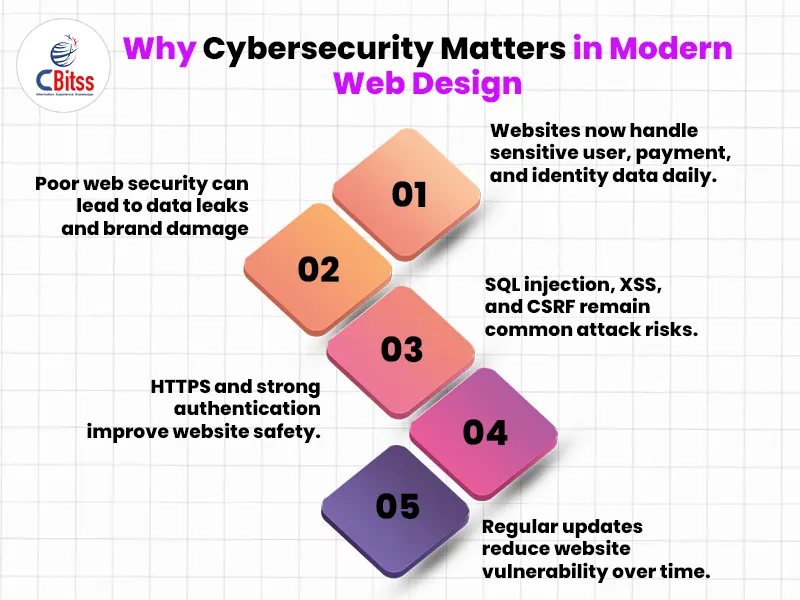
ToggleSecurity has to be regarded as the most important aspect of web design. It is because of constant technological advancements and growing systematic digitalization. The websites that are on the internet incorporate private and/or sensitive data. Furthermore, personal identifiable information, financial information and unique identifiers. Cyberattacks are increasing, so it’s crucial to integrate robust website security measures into the design for protection and resilience. Web design course in Chandigarh is a prerequisite in order to execute the united leap forward in order to secure these websites. Also to ensure users’ privacy and to shape the overall “www” into a secure, safe and verified experience.
Moreover, users now judge a website’s trust through security signs and safe browsing behavior. Therefore, designers must protect forms, payments, cookies, and sessions from the first draft. Likewise, cybersecurity in web design now guides user journeys, admin access, and content delivery. Above all, secure websites build trust faster and reduce legal, financial, and branding risks.
Web Design: The Increasing Demand for Cybersecurity
Today, a website is not a simple, unalterable text, but an arena within which active content is created. It is done through the interaction between consumer and process as materials constantly flow in. Such data-driven constructs include e-commerce sites, social media platforms, and websites of online banking.
However, as these platforms advance, so does the risk and the modern threats have evolved significantly to be more complex. Nowadays, an unsecured internet space is already considered to be profitable by criminals. They expose websites to the threat of data leakage, identity theft, financial losses, and reputational losses for a company.
Web site attacks can culminate into severities such as identity theft, economic loss, and loss of brand reputation. Today, however, they are much more sophisticated. They not only take control of Web sites but also encrypt the sites and hold them for ransom as well!
Considering these risks, website design security is not a luxury but a necessity. Websites are thus at risk of different types of cyber threats like SQL injection, cross site scripting (XSS), code injection.
Due to the increased risks of users’ data theft and secure interaction during the communication, they should implement security measures during the website design stage. It is therefore important that there is a clear structure in place for security measures. It is to reduce the risk of intrusion and compromise of the functionality of the website.
Today, attackers target weak permissions, exposed APIs, outdated plugins, and insecure third-party scripts. Consequently, broken access control remains one of the most serious web application risks. Similarly, businesses must follow secure-by-design practices instead of adding protection later.
Moreover, a best homepage design should limit risky elements and protect key entry points. Meanwhile, serverless and microservices require stronger API gateways, secret storage, and logging controls.
Overview of the Most Frequent Web Security Threats
However, to address practical issues of website security, one has to know what type of risk a website designer faces.
Some of the most common security risks include:
- SQL Injection: In this kind of an attack the attacker can surreptitiously injects SQL code into the input field. To an increased degree, in the absence of appropriate sanitation of the input generated by the user. Then the database of the website is within the attacker’s range of attack. And, simultaneously, it is, for instance, possible to gain access to reading, editing, or deleting private data.
- Cross-Site Scripting (XSS): Currently, XSS attacks are a result of inserting hostile scripts into a website. Although these scripts can be used to carry the user cookies, session tokens, or any other form of confidential information that may be used in compromising the user data.
- Cross-Site Request Forgery (CSRF): Here the perpetrator convinces the victim to carry out an action he or she probably did not willingly. For instance in an operation to withdraw a specific sum of money or alter parameters of an account and so on.
- Malware and Ransomware: Web sites are web sites that can also be a victim for malware to be uploaded on the web site to steal information. Or to harm a user or to reside on the web site for monetary gain. If web designers are aware of these and other cyber attacks the level of ability to defend their websites resides on the fringes of their ability to be attacked.
However, old threat lists are no longer enough for modern websites and apps. For example, attackers now abuse weak API inventory, exposed tokens, and unsafe dependency chains. Likewise, third-party scripts can introduce hidden risks when teams skip monitoring and version reviews.
Therefore, developers should update themes, plugins, libraries, and containers on a strict schedule. Additionally, Content Security Policy blocks unsafe resource loading and reduces script-based attacks. Similarly, browsers now block or upgrade many insecure mixed-content requests automatically. Meanwhile, every Android developer should secure mobile APIs and token storage carefully. Furthermore, students in Python training with placement in Chandigarh should learn validation, logging, and secure deployment.
Protect websites from threats using real-world strategies.
How to get a Protected Web Design?
- Security coding is a design problem in web design. These include the process of moderating user’s input to prevent SQL injection.
- Secondly the process of checking the input of the form to prevent cross-site scripting.
- Thirdly, the process of purging or sanitizing output data to prevent code injection attacks. Web designers have a responsibility to code with which the design is as strong as it can be.
- HTTPS and SSL Encryption- Security Socket Layer (SSL) encryption occupies an especially rather unique place in carrying secrets. Web servers currently have to use the HTTPS (a version of the http protocol). It is so that the information being contacted between the web surfer’s browser and the server is private.
- Strong Authentication Methods- It would also be good to make sure that the given user login is going to be safe so that the user account doesn’t disappear. Multi-factor authentication MFA – a technique in which the user has to type in more than one identification factor. Such as password+fingerprint or one time password.
Therefore, the proper utilization of supervision and security monitoring is necessary not only to reveal the failed system, but to fix it as well, as malware cannot penetrate it. However, web designers can insist that the installed program, plugin or theme in the website never gets out dated and at the same time.
Consequently, teams should validate input on the server, not only in the browser. Moreover, they should hash passwords strongly and protect sessions with secure cookie settings. Likewise, phishing-resistant sign-ins like passkeys can strengthen account security for many users. Then, multi-factor authentication adds another defense layer for high-value accounts.
Similarly, backups, audit logs, and alerts help teams respond before damage spreads. Additionally, role-based access keeps editors, admins, and developers within safe permission limits. In the same vein, best Python training can strengthen automation skills for security checks and testing. Another benefit of PHP training is safer handling of sessions, forms, and database queries. Accordingly, PHP certification and its importance for career grows when backend security becomes a hiring priority. Meanwhile, a complete information of Microsoft Azure helps learners understand cloud backups, identity, and access control.
Stay ahead with secure design and coding practices.
Modern Security Practices Web Designers Should Add
- Above all, teams should map every API version and connected service clearly.
- Therefore, they can remove forgotten endpoints before attackers discover them first.
- Moreover, they should test forms, carts, dashboards, and payment flows regularly.
- Similarly, security reviews must cover design, code, hosting, and cloud configuration together.
- In fact, secure websites improve trust signals, uptime, and user retention.
- Thus, security now supports business growth and better user experience.

Conclusion
- In conclusion, web design succeeds when creativity, usability, and protection work together.
- Overall, businesses should treat security as a core design feature, not a final checklist.
- As a result, secure websites protect data, strengthen trust, and support long-term growth.

Sukhamrit Kaur
Sukhamrit Kaur is an SEO writer who loves simplifying complex topics. She has helped companies like Data World, DataCamp, and Rask AI create engaging and informative content for their audiences. You can connect with her on LinkedIn.