
Table of Contents
ToggleHave you ever questioned yourself about how organizations identify hidden cyber threats in a system log that contains millions of entries? Or wondered, what are SIEM tools, and what is the reason that cybersecurity teams use them on a second-by-second basis?
At the end of this article, you will know what is SIEM tools, the internals of SIEM tools list. More importantly, how SIEM security tool platforms assist professionals in averting data breaches before they occur. You will also find the application of free SIEM tools without doubt, real-world applications, and, more importantly, what do security professionals typically do with SIEM tools in the real world.
Strengthen your understanding of secure web systems by exploring thesignificance of cybersecurity in web design.
Understanding the Layers of SIEM Tools
A SIEM tool (Security Information and Event Management) functions on three basic layers that complement each other in facilitating the detection of threats ahead of time and monitoring compliance.
- Data Collection Layer: Gathers data on servers, firewalls, applications, and cloud systems.
- Correlation Layer: Relates events, identifies anomalies, and points at possible intrusions.
- Response Layer: Alerts, actions, and visual dashboards for the analysts.
The knowledge of these layers can make you understand the basis of what is a SIEM tool. It is not just about recording the events but providing your team with viable information to take action promptly and unhesitatingly. This is what are the SIEM tools in contemporary cybersecurity.
If you’re seeking hands-on training, check out the top cybersecurity institutes in Chandigarh for expert-led SIEM learning.
How It Work in Practice
After that, These tools are fed real-time data and normalised. After standardization of logs, the system recognizes patterns and makes correlations of associated events. The suspicious behavior or anomalies can then be responded to almost in real-time by the analysts.
For example:
- The number of failed user logins could be more than one, which would raise an alarm.
- These are correlated with network traffic spikes or suspicious data access by the security tool.
- In case it is verified to be malicious, it can block the source automatically or quarantine an affected device.
The endless development of analytics enables the list of technologies offered by these tools list to become smarter. They do not simply analyze, but learn how to act after previous attacks, adjust to the emerging threats, and act independently.
Learn how design impacts security with our guide on why UI and UX are important in digital environments.
Learn centralized monitoring, threat detection, and compliance reporting using SIEM platforms.
What is the Difference Between Traditional and Modern SIEM Tools?
Understanding what is SIEM tools, it is important to observe how the systems in the modern days are superior to the traditional systems.
| Feature | Traditional SIEM | Modern SIEM |
| Function | Static log collection and rule-based correlation | Machine-learning-driven analytics and automation |
| Response | Manual, slow alert triage | Automated, near real-time actions |
| Scalability | Limited to on-premises systems | Cloud-native and hybrid environments |
| Analytics | Based on fixed rules | Adaptive behavioral and context-aware models |
The current SIEM security tools platforms are scalable, dynamic, and AI-integrated. They provide predictive data rather than merely after incident records, the redefinition of SIEM tool to a contemporary business enterprise.
Discover how modern networks stay resilient by understanding how cloud computing works alongside SIEM integration.
Understand how SIEM tools detect threats, analyze logs, and secure enterprise systems.
Exploring the SIEM Tools List
The list of SIEM tools is enormous, starting with enterprise-level tools and ending with lightweight open-source tools. These can be categorized into several broad groups:
- Enterprise SIEMs: Enterprise SIEMs are used in large organizations and require all the features of visibility and compliance, including IBM QRadar, Splunk, and Exabeam.
- Cloud-Native SIEMs: Can be used optimally when it comes to hybrid infrastructures and cloud-first infrastructures, and provide scalability and real-time correlation.
- Open-Source and Free SIEM Tools: Free and cheap solutions, such as Wazuh, OSSIM, and ELK stack-based teams.
These have become an attractive point of entry due to increasing interest in the need of these. They enable startups and small businesses to experience what SIEM tools are like before committing to the enterprise versions.
Expand your networking expertise by exploring the scopes of CCNA and how it complements SIEM operations.
Real-World Applications
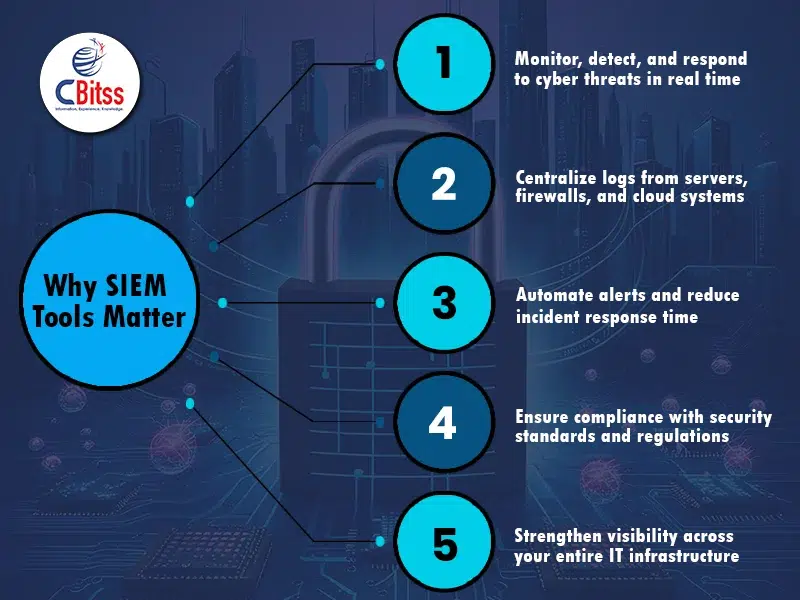
The operation of every Security Operations Center (SOC) is centered on SIEM tools. The following is the way they improve daily cybersecurity practices:
- Threat Detection: Detection of unauthorized access, data leakages, and anomalies in real time.
- Compliance Management: Automatically create reports of such standards as ISO 27001 and GDPR.
- Incident Forensics: Rebuild attack sequences and root causes.
- Cloud Monitoring: Deliver visibility in the multi-cloud infrastructures.
- Automation: Interoperate with SOAR to respond to threats automatically.
With SIEM security tool systems, professionals are able to centralize the detection and improve the remediation process. With the help of these applications, we can observe what is a SIEM tool in operation, a smart guardian to protect all the digital layers.
Visualize security insights more effectively by using the best data visualization tools for SIEM dashboards. Rethink the role of automation and ethics in IT by readingReconsider Artificial Intelligence in Human Resources.
What Do Security Professionals Typically Do with It?
The security personnel use the SIEM tools as their decision-making and defense command center.
- Monitoring: Analysts observe dashboards and assess the abnormalities.
- Investigation: With this in mind, analysts correlate, analyze, and validate these events to confirm real incidents
- Response: With this in mind, automated playbooks then act on identified threats in order to stop them quickly.
- Optimization: Teams continually optimize rules in order to lower the frequency of false positives.
- Reporting: The team creates and presents security posture and compliance reports to management.
Moreover, knowing what do security professionals typically do with SIEM tools demonstrates that they are a useful tool, and that includes being aware of it all the time, analyzing it accurately, and doing so promptly. Such professionals turn what is SIEM tools theory into reality.
Strengthen communication strategies with insights from top email marketing platforms that secure customer data.
Challenges and Limitations of SIEM Tools
However, SIEM tools still have limitations, so with this in mind, teams should address them cautiously.
- High Data Volume: The system gathers such a high volume of logs that it eventually overwhelms storage and analysts.
- False Positives: Badly set rules can inundate teams with spam alerts.
- Integration Complexity: It may be challenging to integrate several cloud-based and on-prem systems.
- Skill Shortages: There is a shortage of skilled SIEM analysts who are in high demand.
- Cost Constraints: Scaling of storage and analytics can be expensive, even with free tools.
It is undoubtedly important to address these factors to optimize the performance of what are SIEM tools and make their use sustainable.
Explore tech career growth by reviewing the highest-paying engineering jobs that intersect with cybersecurity.
Future of SIEM Tools in an AI-Driven World
SIEM vendors will eventually integrate next-generation tools with artificial intelligence and automation; therefore, detection and response will run faster and smarter.
- Predictive analytics will anticipate threats before they emerge; therefore, teams will respond faster and reduce risk.
- Connections with SOAR will automate the entire response cycle; therefore, teams handle incidents faster and more consistently.
- The contextual intelligence will enhance the accuracy in decision-making.
- Further, adaptive learning will refine the alerts, and therefore, the system will not require any rule editing.
- With this in mind, cloud-native security tool designs enhance global scalability; therefore, organizations scale protection faster and more reliably.
The future of these tools undoubtedly is in self-learning, self-healing platforms merging machine intelligence with human supervision – developing a new wave of intelligent cybersecurity.
In fact, learn how AI transforms SIEM by reading about retrieval-augmented generation in modern security analytics. For a quick visual recap, check out our Cybersecurity: The Shield of the Digital Age web story.
Best Practices for Implementing SIEM Tools
Certainly, organizations ought to implement formal approaches in order to ensure that SIEM tools are functional.
- Pick and choose the most important systems first.
- Scalability actually uses modular integrations using API.
- Above all, use free tools of the SIEM to test out and prove of concept early.
- Periodically update threat feeds and correlation rules.
- Periodic Audits, accordingly, and records of compliance.
- Although train analysts constantly undergo training to perform at the maximum level.
Therefore, by following these practices, you ensure your tool list deployment stays reliable, adaptable, and efficient.
Stay ahead of automation trends with AI chatbot secrets every student should learn in cybersecurity training.
Conclusion
Understanding what are SIEM tools provides clarity on how they protect networks, data, and organizations worldwide. You now know what is a SIEM tool, as well as how they differ from older systems. From the expanding SIEM tools list to innovative free SIEM tools, these technologies empower professionals to secure digital infrastructures efficiently.
Knowing what security professionals typically do with SIEM tools to get a full picture of the operational strength of the tools, an ideal combination of data, intelligence, and human wizardry that will push the cycle of cybersecurity to the next stage.
Understand how practical programs gain credibility through the CBITSS cybersecurity course industry acknowledgmentcase study.

J. Julia Kamei is a professional content writer with 4+ years’ experience creating impactful content for clients in the USA, India, Canada, the UK, and Europe. An M.A. History graduate, she specializes in immigration, business, IT, digital marketing, AI, and Data Science. She also mentors students for international education and research.