

Table of Contents
ToggleIntroduction
Advanced Graphic Design Classes in Chandigarh help you understand design principles, of newest technologies and applied techniques. Graphic design is some of the most in demand today in almost all fields of today’s market.
Moreover, modern graphic design now combines traditional creativity with generative AI, motion design, UI/UX, and intelligent design tools.
As a result, designers can explore ideas faster while maintaining creative control over final visual outcomes.
It needs to be pointed out that career opportunities in the field of graphic design are expanding. Education enthusiasts will find many different graphic design classes among the most progressive ones in the city of Chandigarh. You can easily enroll in the graphic designing course in chandigarh for in depth knowledge in this field.
Additionally, learners can compare online graphic designing courses when flexibility and remote learning matter.
Meanwhile, modern designers increasingly need skills in AI prompting, visual storytelling, interaction design, and digital accessibility.
Therefore, advanced training now involves much more than simply mastering traditional editing software.
Why should you take Advanced Graphic Design Classes in Chandigarh?
There are classes for beginners and courses and workshops for those who begin their career as designers. And also those who want to improve their skills.
Firstly, these courses offer the students an opportunity to learn from and interact with professionals in the field. In this case, you are learning from people with lots of experience. Hence you are always in touch with the prevailing currents.
In addition, these classes are geared toward more practical education. Students actively work on lively projects and realistic course assignments, experiencing real-life scenarios that strengthen their professional skills.
Also, design interns can easily get internships or jobs because they are close to other designers, agencies, and studios.
Furthermore, advanced classes can expose learners to AI-assisted workflows already becoming common across professional creative platforms. For example, designers can generate concepts, remove objects, extend compositions, create vectors, and test visual variations using AI.
However, strong design principles remain essential because AI-generated visuals still require human judgment, refinement, and brand consistency. Therefore, successful designers increasingly combine creative thinking with efficient AI-assisted production methods.
Modern Graphic Design Is Becoming AI Assisted
- Generative AI is currently one of the biggest changes affecting professional graphic design workflows.
- For instance, Photoshop allows designers to add, remove, expand, or regenerate image elements through natural language instructions.
- Similarly, Illustrator can generate editable vectors, patterns, shape fills, and expanded artwork through generative AI tools.
- Consequently, designers can move from rough concepts to editable visual assets considerably faster.
- Furthermore, AI does not only generate images because modern tools also assist with layout exploration and interface prototyping.
- Figma AI, for example, can create early designs, replace content, edit images, and build prototype interactions.
- Therefore, students should learn how to use AI for exploration while retaining control over typography, composition, branding, and accessibility.
- At the same time, understanding what is data science can support designers working with dashboards and data-driven products.
- Moreover, data literacy helps designers present complex information through clearer visualizations and more understandable digital interfaces.
Stay ahead of the curve by learning AI-powered design techniques for the web.
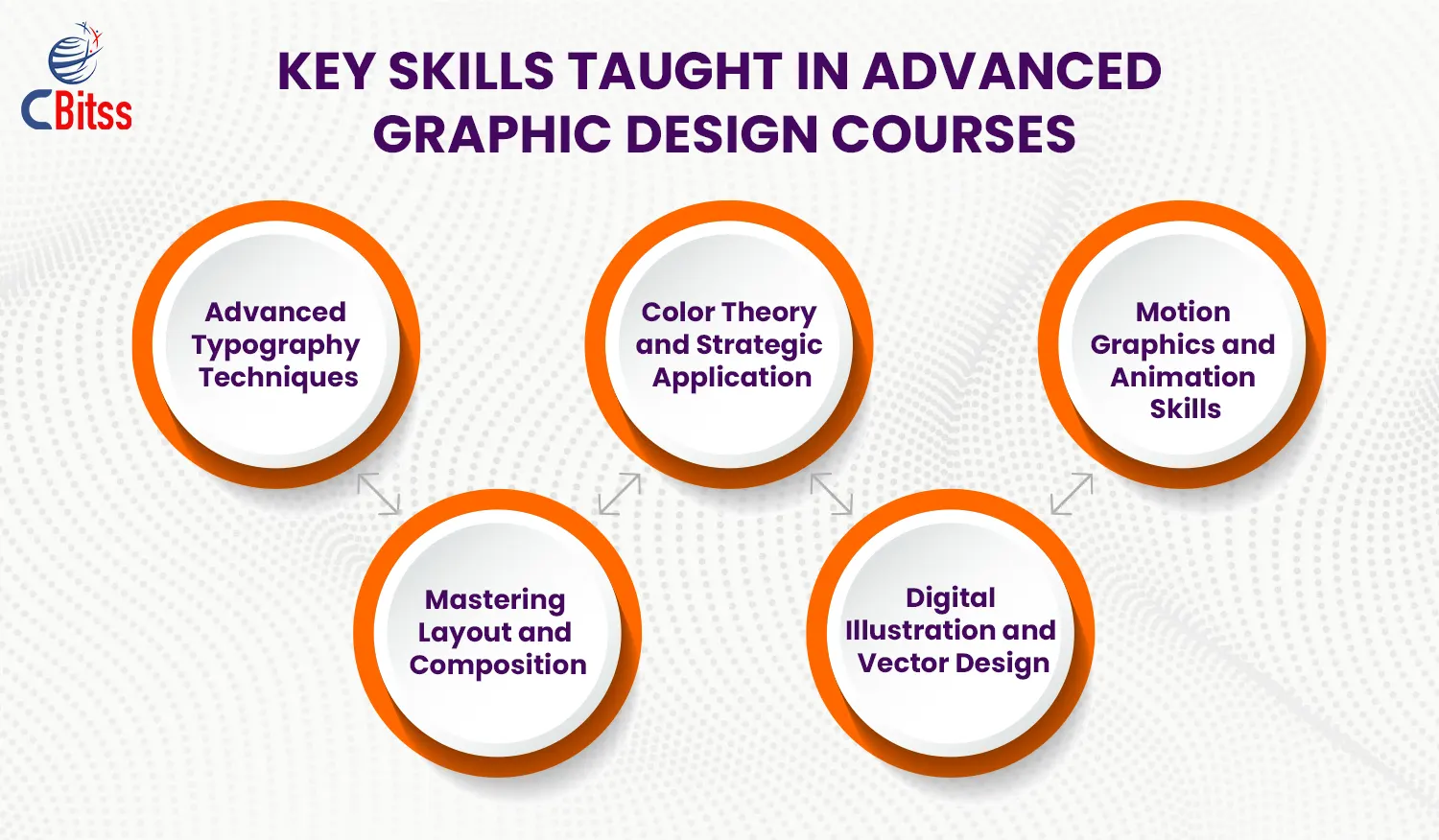
Skills taught in Advance Graphic Design Courses
Taking advanced graphic design classes actively equips individuals with skills unavailable through basic design information. Here are some key skills you can expect to learn:
- Mastery of Design Software– Advanced courses focus on proficiency when it comes to tools relevant to the industry. For example Adobe Photoshop, Illustrator and In-design. You also receive motion graphics skills with the help of Adobe After Effects and other 3D modeling tools including Blender. Fluency in these tools enables you to achieve wonderful, unique looks and great designs.
Moreover, modern Photoshop workflows include generative editing, intelligent image expansion, AI upscaling, and automated visual adjustments. Similarly, Illustrator now supports AI-generated vectors and editable creative assets that accelerate ideation without replacing manual refinement.
- Advanced Typography– Typography is one of the critical components of graphic designing. You learn various topics such as how to select and combine different types of fonts. Further how to organize them based on a hierarchy, and the emotions that fonts can evoke from an audience.
Additionally, modern typography increasingly considers responsive layouts, variable fonts, readability, accessibility, and consistent digital brand systems.
- Branding and Identity Design– Main among them is designing outstanding brand images. It will also teach you how to develop logos, colors and graphic standards that are appealing to the target customer base.
Furthermore, AI can accelerate mood boards and concept variations while designers maintain strategic control over brand identity. Therefore, learners must understand consistency, originality, audience research, and visual communication alongside AI tools.
- UI/UX Design– Looking at today’s workflow, which is more or less inclined digitally, UI/UX competencies are essential. The intermediate and advanced classes show how to create good looking navigations for sites and applications. Thereby focusing on both effectiveness and pleasant appearance.
Moreover, modern UI/UX workflows increasingly involve AI-generated wireframes, interactive prototypes, design systems, and accessibility testing.
Learners can also compare top UI UX institutes when exploring specialized interface design training. Consequently, designers must balance visual appeal with usability, accessibility, responsive behaviour, and measurable user experience.
- Motion Graphics and Animation– Everyone seems to be getting into the act of using animation in their businesses. You will also discover techniques on how to design animated elements and motion graphics that can be quite essential in sales pitches and numerous markets today.
Additionally, motion is becoming more important across social content, interfaces, digital campaigns, product demonstrations, and brand storytelling. Therefore, designers who understand animation timing and visual hierarchy can create more engaging digital experiences.
- Design thinking problem-solving– In addition, the curriculum of the advanced graphic design classes will also show you how to best think solving problems. Design thinking is about recognizing user requirements and identifying ideas as well as great solutions.
Moreover, AI can accelerate brainstorming, but designers still need research and critical thinking to identify genuine user problems. Therefore, human-centered design remains essential even when creative production becomes increasingly automated.
- Portfolio Development– Portfolio is the key to opening your careers door. It means that in order to get a certain job then you should have a proper portfolio. You will be required to develop various projects that you can use to market yourself to employers or clients.
However, employers increasingly value portfolios that explain the design process rather than displaying finished visuals alone. Therefore, learners should demonstrate research, ideation, revisions, problem-solving, AI usage, and final design decisions.
Stay ahead of the curve by learning AI-powered
Emerging Skills for Modern Designers
- Graphic designers increasingly work across branding, UI/UX, motion graphics, social media, web experiences, and digital products.
- As a result, multidisciplinary skills can provide more flexibility across creative roles and project types.
- Furthermore, 3D design is becoming more accessible through tools that simplify modeling, visualization, and digital asset creation.
- Meanwhile, AI-generated imagery can accelerate early-stage experimentation for advertisements, concepts, campaign visuals, and presentations.
- However, designers must review generated assets carefully for accuracy, originality, visual consistency, and commercial suitability.
- Accessibility is another important trend because digital designs should work effectively for people with different abilities.
- Therefore, designers should understand colour contrast, readable typography, navigation clarity, scalable interfaces, and inclusive design principles.
- Additionally, data visualization is creating overlap between design and analytics-focused careers.
- Learners interested in analytical visualization can explore data science certificate programs to understand data-driven workflows.
- Similarly, knowledge of online versus classroom SQL training can support designers working on dashboard-based products.
- Consequently, combining visual communication with basic data knowledge can be valuable for dashboards and business intelligence interfaces.
Selecting the Appropriate Graphic Design Course
To find the best course, consider the following factors:
- Curriculum: Make sure that it entails more complex material within fields such as motion graphics, UI/UX and branding. Additionally, check whether the curriculum covers generative AI, modern Adobe workflows, prototyping, accessibility, and portfolio development.
- Faculty: Find tutors with practice in the field you are learning about. Moreover, instructors should understand both traditional design fundamentals and modern AI-supported creative workflows.
- Infrastructure: Select the modern equipment of the institutes and the design of the applications.
Furthermore, students should receive access to relevant design software and systems capable of supporting modern creative applications.
- Practical Learning: These should encourage practical assignments such as projects and portfolios to be done. Therefore, choose training that includes realistic branding, social media, UI/UX, motion, and portfolio projects.
- Placement Assistance: Lastly see if the institute offers best graphic designing courses any form of job placement assistance. Additionally, strong placement support should include portfolio reviews, interview preparation, career guidance, and practical project feedback.
Learning Graphic Design for Modern Careers
Graphic design courses will give you the opportunity of building great careers in advanced graphic designing. These courses provide you with just the right amount of academic content.
They combine it with on the job experience. This helps ensure that you are competitive in a saturated market. Moreover, modern graphic design careers increasingly reward professionals who combine creativity with technology and user-centered thinking.
Therefore, learners should understand design fundamentals before depending heavily on automated or generative tools. AI can accelerate repetitive production tasks, generate variations, and support experimentation.
However, designers remain responsible for creative direction, brand consistency, usability, accuracy, and final visual quality. Consequently, the strongest portfolios will demonstrate both creative judgment and smart use of emerging technologies.
It is high time that you start painting the world. Start moving toward making yourself a prominent graphic designer!

Sukhamrit Kaur
Sukhamrit Kaur is an SEO writer who loves simplifying complex topics. She has helped companies like Data World, DataCamp, and Rask AI create engaging and informative content for their audiences. You can connect with her on LinkedIn.