

Table of Contents
ToggleHave you ever questioned yourself about how companies find a way to process massive amounts of data that flows at a high pace and transform it into calm, concrete conclusions? In this article, you will discuss the use of big data analytics tools, which are used in modern systems to process heavy datasets.
Also, you will explore analytical tools in big data, the history of the modern analytical ecosystem, and understand how the new technologies transform the industries of the global world. Last but not least, you will find out how to think practically regarding tools beyond buzzwords. At the bottom of this article, you will definitely understand how these solutions can be combined to provide accurate and highly scalable business intelligence.
Visualize insights effortlessly with the best data visualization tools.
Understanding the Foundation of these Tools
First of all, what is big data analytics tools is much broader than software that works with big files. These tools develop a structured setting through which teams derive meaning from unstructured, semi-structured, and structured data at inconceivable rates. Meanwhile, organizations use them to spot relationships, behaviors, anomalies, and patterns that traditional systems miss.
Moreover, the concept of what are big data analytics tools is indicative of a transition from basic data processing to an entire level of intelligence creation. As a result, the toolsets have become the foundation of whole data strategies by companies that need to remain competitive in uncertain environments.
Build a strong foundation for your career by mastering essential data science skills.
Major Categories and Capabilities
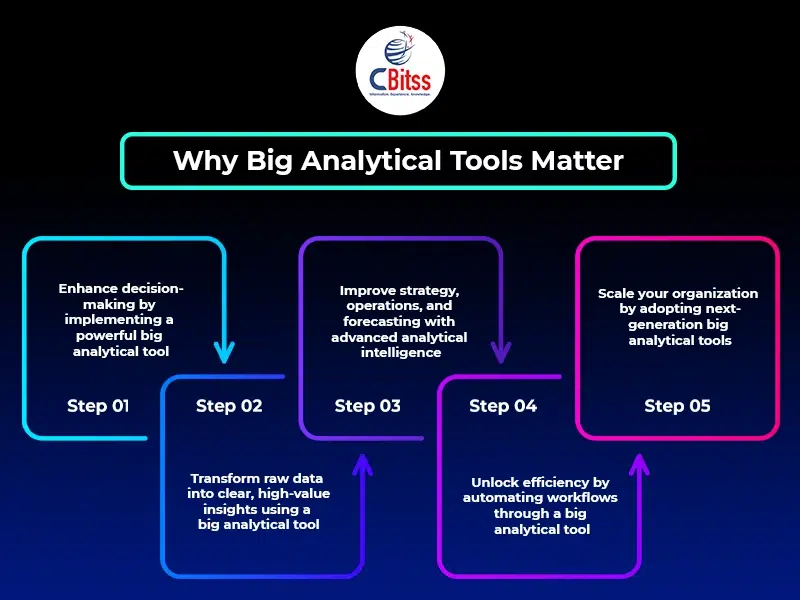
- Firstly, various big data analytical tools are first used by engineers to handle ingestion, cleansing, transformation, modeling, and visualization within a single workflow.
- Next, organizations compare tools of big data analytics in terms of speed, compatibility with the data type, scale, and flexibility of the algorithm.
- Additionally, leaders enquire about what is big data analytics tools to learn how the systems can facilitate automation, machine-learning pipelines, and real-time insights.
- In addition, developers also combine them with existing infrastructures to achieve the maximum of interoperability and the least architectural complexity.
- Lastly, decision-makers are dependent on the things what are the tools used for big data analytics to predict risks and opportunities and assist in contemporary predictive systems.
Start your journey in analytics with the globally recognized Google Data Science Certification.
Learn tools required for analytics jobs today.
Learn Industry Tools With Practical Training:
Modern Applications Reshaping Industries
Interestingly, large-scale analytics now supports industries beyond technology and finance, and it continues expanding across new sectors. With this in mind, agriculture uses real-time mapping and predictive modeling to track soil health and climate. Similarly, medical institutions question what are the tools used for big data analytics, and they are in a better position to utilize patient information to predict epidemics, staffing, and customized care. Moreover, the modern production facilities incorporate sensors to continuously input data about functioning into the work of analytical machines to increase accuracy and effectiveness.
Therefore, retailing businesses optimize stocking, pricing, and client interactions by using data-driven evidence based on various channels. Moreover, emerging markets apply big data to control traffic systems, utility grids, and public services, as well as sustainability programs.
However, these programs process massive data streams that conventional tools cannot handle. With this in mind, developers should quickly build modern instruments to support society and the private sector. Last but not least, due to the expansion of real-time ecosystems, organizations understand that big data is not a technical resource at all, but a strategic tool.
Strengthen your analytics journey by learning how Python is used in data analysis.
Essential components of effective toolsets
- To begin with, the design of the big data analytic tools consists of distributed storage engines, high-performance computation architectures, and real-time processing layers.
- As well as latency performance, cluster stability, and adaptive scalability are commonly used to benchmark analytical tools in big data.
- Furthermore, teams compare tools of big data analytics based on their ability to handle schema changes, lineage, and management of metadata.
- Besides this, companies evaluate big data analytics solutions on their integration with the AI, automation, and environment orchestration systems.
- Lastly, the leaders investigate what is big data analytics tools to determine the accuracy of decision-making across departments through automation.
Make smarter career choices by understanding the difference between data science and data analytics.
Challenges that shape the evolution of tools
Amazingly, the most sophisticated solutions are not devoid of challenges that affect their adoption of a solution by organizations. The variety of data is one of the largest challenges since big data comes in a variety of forms: text, video, streaming logs, IoT signals, etc. Besides, quality maintenance in the process of ingestion requires continuous verification and noise minimization. Enterprises also need to store these enormous datasets without compromising performance.
As a result, the designers of tools are providing encryption, authentication, and real-time monitoring to current platforms. In addition, complexity is increased because businesses combine various sources. Also, they should make sure that there is a smooth interchange between systems and avoid data silos. Similarly, organizations must have easy-to-navigate interfaces in order to enable non-technical groups to use insights without necessarily involving technical experts. Lastly, ongoing innovation is necessary since the antiquated systems are unable to support the growing pace and amount of world data.
Discover why mastering Python matters with Python for data science.
Learn tools that companies demand in hiring.
Role of Tools in Large-Scale Transformation
- First, current businesses rely on what are big data analytics tools to process AI-ready data with precision and speed.
- With this in mind, teams use big data analytics tools to forecast failures, automate responses, and guide operational decisions.
- Next, the decision makers would consider analytical tools in big data to create resilient business models against uncertainty.
- Also, leaders use the tools of big data analytics in developing the strategies of digital transformation that are high-impact.
- Lastly, developers maximize pipelines using the deployment of these big data tools that facilitate distributed computing and parallel processing.
Stay ahead of the curve by exploring the latest data science trends.
Future Direction
In the future, the development of big data analytics tools is going to evolve at a faster rate. The new architectures will depend on automation, adaptive learning, and self-optimizing to a large extent. In addition, the next-generation tools will combine contextual intelligence, so the systems will be able to alter model behavior depending on environmental conditions. Also, the cross-platform interoperability will remove vendor lock-in and will offer organizations greater freedom to architect, deploy hybrid, cloud-native, and on-premises ecosystems.
This means that analysts will operate with much clearer, explainable, and easier to collaborate with systems. Similarly, global industries demand fairness, privacy, and accountability, so ethics in data will shape future tool development. Organizations will embed auditability and traceable decisions into tools; meanwhile, real-time analytics will reshape energy, mobility, and communication technologies. Lastly, since data is growing exponentially, tools should be becoming smarter and not necessarily bigger.
Upskill creatively by joining the top UI UX institutes in Chandigarh.
Conclusion
To sum up, big data analytics tools are of utmost importance in assisting organizations to convert the massive data flow into viable, useful intelligence. Additionally, the tools enable teams to react to market changes in a fast, precise, and strategy-driven manner.
Also, they open up innovation by bringing out concealed patterns and opportunities that are not felt by traditional systems. With this in mind, companies embed them across digital ecosystems to strengthen decisions and keep operations resilient. After all, organizations use smart, adaptive, scalable tools to stay competitive as data grows in size, speed, and complexity.
Build strong database expertise with MySQL training or transform data into decisions using Power BI for data analysis and visualization.
Ready to unlock the full power of your data? The modern world is where these big data tools can create a beneficial impact to improve decision-making, enable faster innovation, and achieve a competitive advantage. You should start exploring these tools today. Additionally, adopting the correct tools today will enable you and your organization to succeed in a future in which data-driven intelligence is the key to success.
Elevate your Android development skills with the Android Intents guide.

Sukhamrit Kaur
Sukhamrit Kaur is an SEO writer who loves simplifying complex topics. She has helped companies like Data World, DataCamp, and Rask AI create engaging and informative content for their audiences. You can connect with her on LinkedIn.